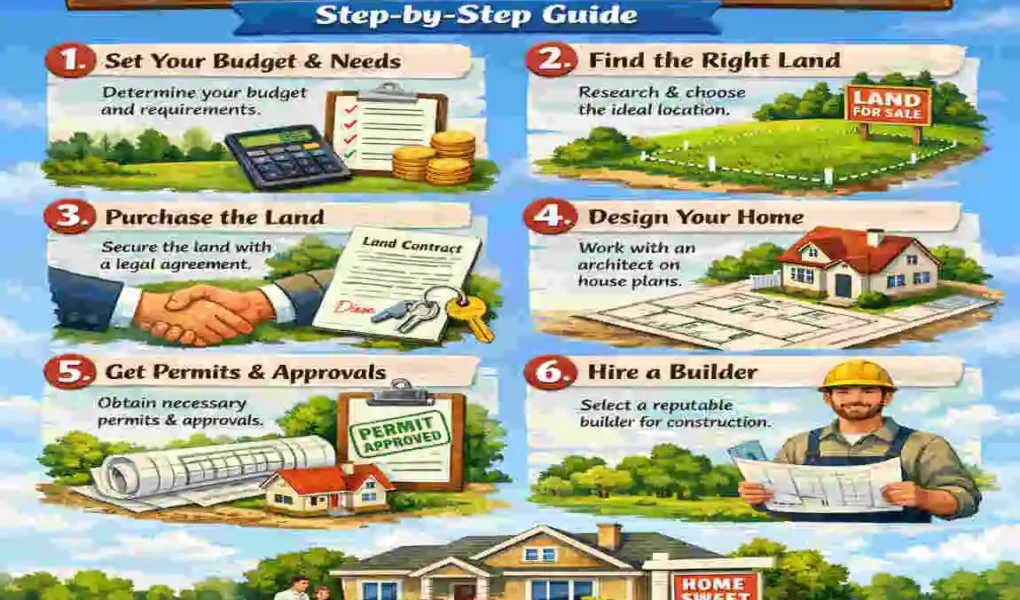
You pull into the driveway, the gravel crunching beneath your tires. You look up, and there it is—not just a house, but your house. It stands exactly where a patch of empty dirt used to be. The windows catch the afternoon sun, the layout is perfectly tailored to your family, and you know every single brick was laid with your approval.
It’s a beautiful dream, isn’t it? But for many, the gap between that dream and reality feels like a canyon. The real estate market can be intimidating, especially with the fluctuating trends we see in places like Lahore and across Pakistan. You might be asking yourself, ” Is it really possible to learn how to buy land and build a house without losing my mind or my life savings?”
With the real estate market stabilizing and post-2025 recovery trends kicking in, there has never been a better time to take control of your housing destiny. Building your own home rather than buying a pre-built one can save you 20% to 30% on total costs. Plus, you avoid the hidden defects of someone else’s construction.
Define Your Vision and Budget
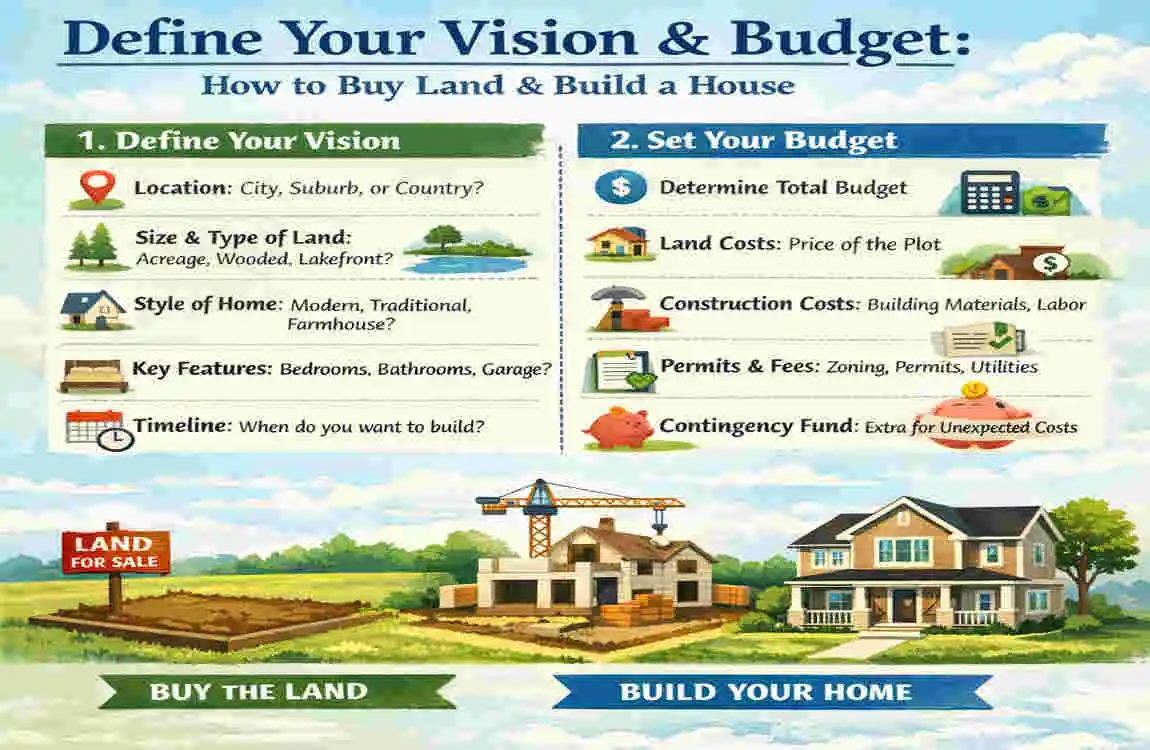
Before you ever scroll through a property listing or talk to an agent, you need a plan. You wouldn’t go on a road trip without a map, and you definitely shouldn’t spend millions without a blueprint for your finances.
Clarify Your Needs
First, sit down with your family and have an honest conversation. What does your life look like in five years? In ten years?
- Family Size: Do you need room for growing children or aging parents?
- Location: Are you looking for the convenience of urban Lahore (near MM Alam Road or Gulberg) or the peace and larger square footage of the suburbs (like DHA Phase 9 or Bahria Town)?
- Style: Are you dreaming of a sleek, modern villa with glass facades, or a traditional home with verandas and brickwork?
Create a Realistic Budget
This is where rubber meets the road. You need to know exactly how much you can spend. In the current market, prices can vary wildly.
- Land Costs: In a prime area of Lahore, a 5-to-10 Marla plot can range anywhere from PKR 5 Million to PKR 20 Million, depending on the society.
- Construction Costs: Currently, turning a grey structure into a finished home costs between PKR 3000 and PKR 5000 per sq ft, depending on the quality of finishes (A-Category vs. Premium).
- The “Oops” Fund: Always, and I mean always, add 10-15% for contingencies. Prices of steel and cement fluctuate, and you don’t want to be stuck with a half-built house.
Sample Budget Breakdown
Here is a rough estimate for a standard 5 Marla (approx. 1125-1350 sq ft plot) double-story house project to give you a clear picture:
Category Description Estimated Cost (PKR)
Land Cost 5 Marla Plot in a developing society 5,000,000
Construction Grey Structure + Finishing (2000 sq ft covered area) 10,000,000
Permits/Fees LDA approval, map passing, utility connections 500,000
Total Estimated Project Cost 15,500,000
Research and Select the Perfect Land
Now that you have your money sorted, it is time to go shopping. This is the most critical part of learning how to buy land effectively. You can change your paint color, but you cannot change your location.
Location Scouting
Don’t just look at the price tag. Look at the lifestyle.
- Proximity: How far is the nearest grocery store? Is there a good school nearby?
- Access: Is the approach road wide enough? In cities like Lahore, getting stuck in narrow lanes is a daily struggle you want to avoid.
- Legality: This is huge. Only look at societies approved by the relevant authorities, such as the Lahore Development Authority (LDA). Illegal societies might be cheaper, but they are a trap that can lead to litigation or demolition.
Key Factors to Inspect
When you stand on a plot, look down.
- Soil Test: Is the ground solid? If the land is a landfill or is near a riverbed, your foundation costs will skyrocket.
- Topography: Is the plot level? Filling a deep depression requires hundreds of truckloads of earth, which costs money.
- Utilities: Are gas, electricity (WAPDA), and sewerage lines actually laid, or just promised in a brochure?
Tools to Use
Use technology to your advantage.
- Google Earth: Check the historical timeline to see how the area has developed over the last 5 years.
- Portals: Use Zameen.com or Graana to compare prices, but always verify them in person.
The Land Buying Checklist
Before you commit, check these boxes:
- Legal Title Verification: Request the Fard (ownership document) and verify the registry.
- Zoning Laws: Confirm the plot is zoned for residential use, not commercial or agricultural.
- Litigation Check: Ensure there are no court stays on the land.
- Measurements: Physically measure the plot dimensions. Don’t trust the map unquestioningly.
Secure Financing and Get Pre-Approved
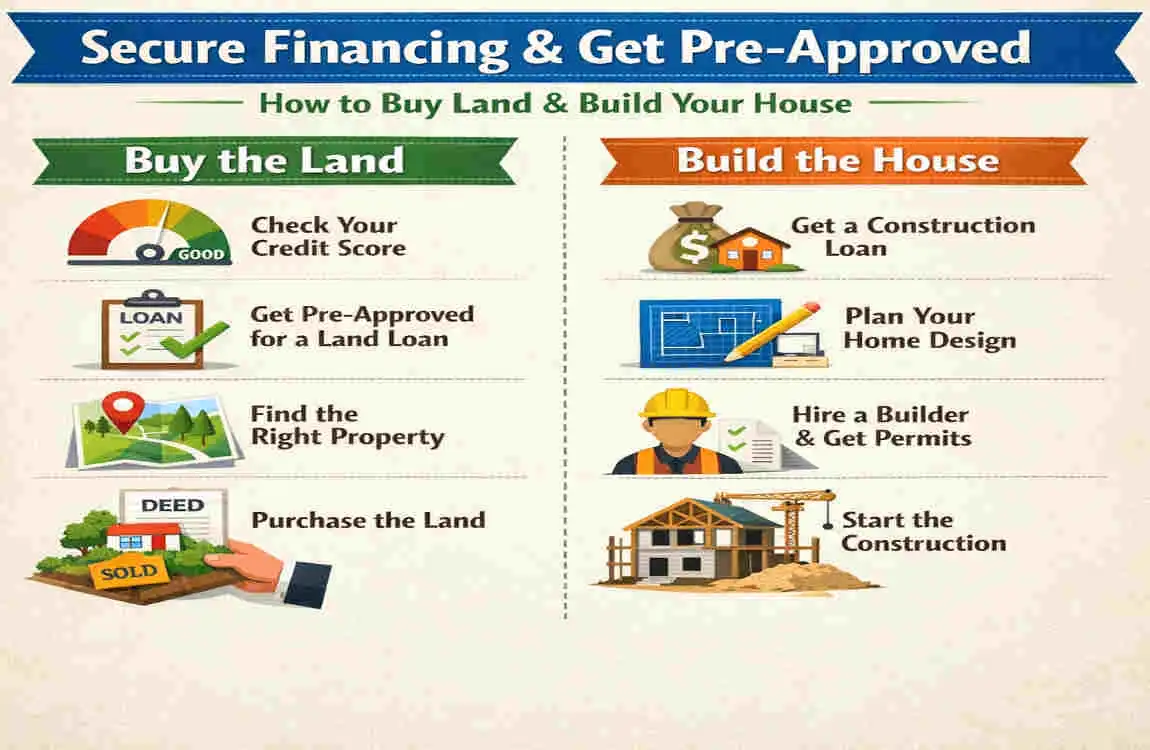
You have found the land, but do you have the cash? If you aren’t buying outright with savings, you need a plan. You should never sign a deal without knowing the funds are ready.
Financing Options
In Pakistan, mortgage financing has improved significantly.
- Bank Loans: Major banks like HBL, Meezan Bank, and Bank Alfalah offer home construction loans. Islamic financing (Diminishing Musharakah) is a popular option.
- Government Schemes: Keep an eye out for SBP (State Bank of Pakistan) subsidized housing schemes, which often offer lower interest rates for first-time builders.
- Developer Financing: Some societies offer installment plans (1-3 years), which can ease the burden, though the total price is usually higher.
Documentation You Will Need
Get your paperwork folder ready. You will typically need:
- Valid CNIC.
- Proof of Income (Salary slips or bank statements for businesses).
- Copy of the property documents (even if you haven’t bought it yet, the bank needs to value it).
Calculate Affordability
A good rule of thumb is the 30-40% rule. Your monthly loan repayment (EMI) should not exceed 40% of your monthly income.
Example Scenario: If you take a PKR 10 million loan at a 15% annual interest rate for 20 years, your monthly installment could be around PKR 130,000-150,000. Ensure your household income can support this without stress.
Make an Offer and Close the Land Deal
This is the handshake moment. You found the plot, and you have the money. Now, you need to navigate the actual buying land process in Pakistan.
Get a Valuation
Before you quote a price, ask a local dealer (who isn’t the seller’s agent) what the last three plots in that street sold for. Knowledge is power.
Negotiate the Price
Sellers always price high. Start your offer 10-15% below the asking price. Be ready to walk away; it’s the strongest negotiation tactic you have.
The Token Money
Once a price is agreed upon, you pay “Token Money.”
- Conditional Token: A small amount (e.g., PKR 50,000) to show interest.
- Confirmed Token: A larger sum (e.g., 5-10% of total value). Get a receipt!
The Agreement to Sell (Bayana)
This is a legal document outlining the price, the payment schedule, and the handover date. It effectively locks the deal.
Transfer and Registry
You will go to the Sub-Registrar’s office or the Society Transfer Office.
- You will pay the remaining balance via Pay Order (Demand Draft).
- You will pay government taxes (Stamp Duty, CVT, and Advance Tax).
- The land is transferred to your name. Congratulations, you are a landowner!
Obtain Necessary Permits and Approvals
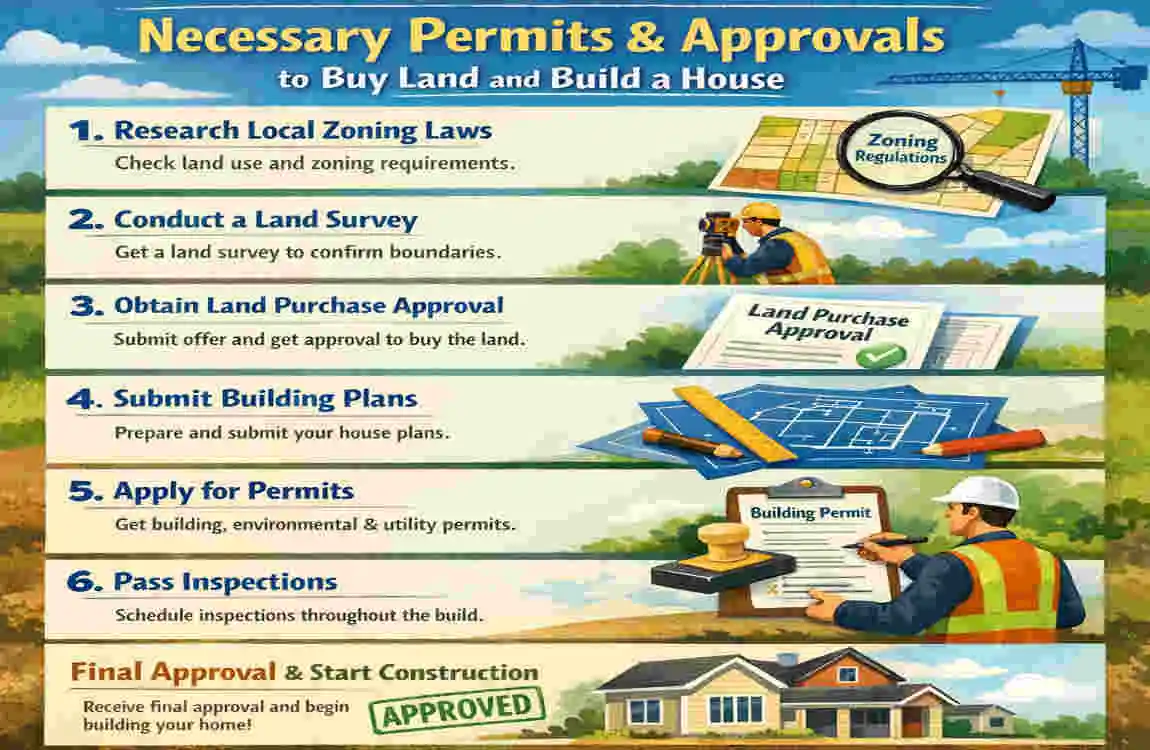
You own the land, but you can’t lay a brick yet. You need the “Green Light” from the authorities.
Understanding the Red Tape
If you build without approval, the authorities (such as the LDA in Lahore or the CDA in Islamabad) have the right to demolish your structure. Do not skip this.
The Approval Process
- Submission: Your architect submits the site plan and building maps to the local authority.
- Vetting: They check whether your design complies with bylaws (e.g., leaving 5ft of open space at the back, height restrictions).
- NOCs: You may need No Objection Certificates from neighbors or utility companies.
Timeline and Costs
- Time: Expect this to take 1 to 3 months.
- Cost: Government fees can range from PKR 50,000 to PKR 200,000, depending on the covered area.
- Map Validity: Once approved, maps are usually valid for 2 years. If you don’t build by then, you have to renew them.
Common Pitfall: Many people extend their sunshades or rooms beyond the allowed limit. This leads to heavy fines (compounding fees) or partial demolition later. Stick to the rules!
Hire Architects and Contractors
A house is only as good as the team that builds it. This is not a DIY project.
The Architect: The Dreamer
An architect does more than draw lines. They optimize airflow, light, and space.
- Fees: In Pakistan, architects usually charge PKR 100-200 per sq ft for design and supervision.
- Deliverables: Floor plans, 3D elevation, electrical drawings, and plumbing layouts.
The Contractor: The Doer
You have two main choices here:
- Labor Rate Contract: You buy the materials; the contractor provides the labor. Good if you have time to shop for cement and steel daily.
- With a Material (Turnkey) Contract: The contractor manages everything. More expensive, but zero stress for you.
Architect vs. Contractor Roles
Role Primary Responsibilities
Architect Design concept, structural drawings, government approvals, aesthetic supervision.
Contractor Sourcing labor, managing daily construction, material procurement, and site safety.
Finalize House Design and Materials
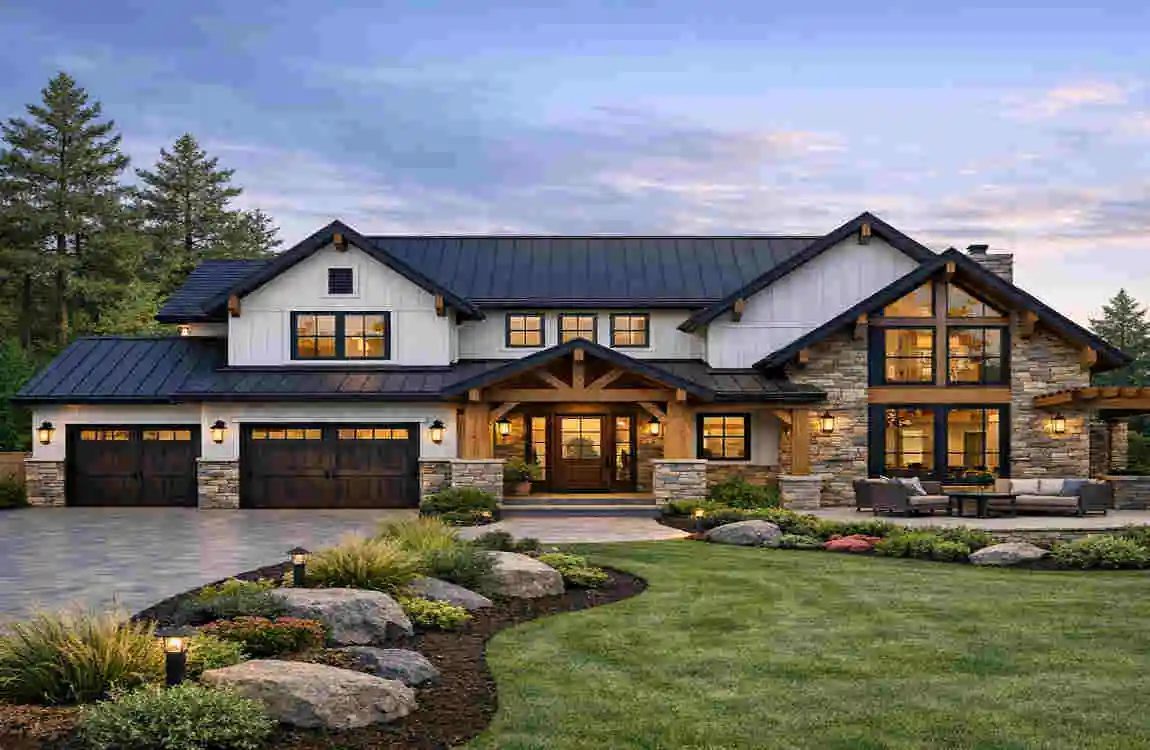
This is the fun part! You get to decide what your dream home looks like.
Smart Design Choices
- Layout: For a 5-10 Marla house, a 3-bedroom or 4-bedroom layout is standard. Open kitchens are trendy, but “dirty kitchens” (grease kitchens) are practical for Pakistani cooking.
- Ventilation: Ensure cross-ventilation. It gets hot in Lahore; a well-designed house reduces AC bills.
Material Selection
This is where your budget lives or dies.
- Flooring: Local marble (Sunny Grey, Badal) is cheap and durable. Imported tiles look great but cost twice as much.
- Woodwork: Solid Ash wood is expensive. Laminated sheets or UV sheets for wardrobes save money.
- Sustainability: Consider installing solar panels immediately. The ROI on solar in Pakistan is now under 3 years due to high electricity tariffs. Also, invest in roof insulation (Jumbolon) to keep the heat out.
Start Construction – Phase-by-Phase
The map is approved, the team is hired, and the materials are picked. Let’s break ground. The house construction process generally follows these phases.
Phase 1: Excavation and Foundation (Month 1)
- The plot is leveled.
- Trenches are dug.
- Termite-proofing spray is applied (Crucial step!).
- The foundation (raft or strip) is poured with concrete.
Grey Structure (Months 2-4)
This is the skeleton of your house.
- Brickwork: Walls go up.
- Lintels: Beams above doors and windows are poured.
- Roofing (Lanter): The roof slab is poured. This is a major milestone.
- Plumbing/Electrical: Conduits (pipes) are cut into the walls.
Finishing (Months 5-7)
This is where the house becomes a home.
- Plastering: Walls are smoothed out.
- Flooring: Tiles or marble are laid.
- Woodwork: Doors, cabinets, and wardrobes are installed.
- Paint: Base coats and final coats.
- Fixtures: Lights, fans, and bathroom fittings are installed.
Monitoring Progress
You cannot be a passive observer.
- Visit the site weekly. Check if the walls are straight. Check that the cement mix is correct (usually 1:4 for brickwork).
- Take photos. Documenting the wiring before it gets plastered over is a lifesaver for future repairs.
Manage Costs and Avoid Delays
Construction projects are notorious for going over budget. Here is how you stay on track.
Track Every Rupee
Use a simple Excel sheet or apps like Buildertrend to track expenses. If you are buying materials, keep every receipt.
The Inflation Hedge
Material prices rise fast. If you have the storage space and the cash, buy non-perishable materials (like steel bars, tiles, and fixtures) upfront. This locks in your price.
Dispute Resolution
Disagreements happen. Ensure your contract with the builder has an arbitration clause. It’s better to pause work for a day to resolve a conflict than to fire a contractor and stall for months.
Move In and Maintain Your New Home
The paint is dry, and the keys are in your hand. You did it!
The Final Setup
- Utilities: Ensure the electricity meter is installed and the gas is connected.
- Snag List: Before the contractor leaves for good, walk through the house. Open every window, flush every toilet, turn on every switch. Make a list of things that need fixing (the “snag list”) and get them done before making the final payment.
Long-Term Maintenance
A house is a living thing.
- Clean your water tank every 6 months.
- Check your roof for leaks before the monsoon season.
- Service your termite protection every few years.
Common Mistakes to Avoid When You Buy Land and Build a House
Even smart people make these errors. Don’t be one of them.
- Skipping the Soil Test: You might save PKR 20,000 now, but you will spend millions fixing a sinking foundation later.
- Under-Budgeting Utilities: People budget for the house but forget the connection fees for gas, electricity, and society membership, which can add up to PKR 500,000.
- Ignoring Resale Value: You might love a purple bathroom, but buyers won’t. If you plan to sell eventually, keep the fixed elements (tiles, layout) neutral.
Frequently Asked Questions (FAQs)
Q1: How much does it cost to buy land and build a house in Lahore? A: As of 2026, for a standard 5 Marla project in a decent society, you are looking at approximately PKR 15 Million to PKR 20 Million. This includes land costs (approx. PKR 5-8M) and construction costs (approx. PKR 10-12M).
Q2: How long does it take to buy land and build a house?A: The entire process usually takes 12 to 18 months. Buying and closing on the land takes about 1-2 months, design and permits take 2-3 months, and construction takes 9-12 months.
Q3: Is it cheaper to buy land and build, or buy a ready-made house? A: Generally, building is cheaper. You can save 20-30% of the developer’s margin. However, it costs you time and effort. If you value your time highly, a ready-made house might be “cheaper” in terms of stress.
Q4: Can I get a loan for buying land only?A: Most banks in Pakistan prefer lending for “construction” or “purchase + construction.” Loans strictly for buying open plots are rarer and often have higher interest rates or stricter down payment requirements.
Q5: What is the difference between Grey Structure and Turnkey? A: Grey Structure means the building skeleton (walls, roof, plaster, plumbing pipes) is done, but no paint, tiles, or wood. Turnkey means the house is fully finished, and you have to turn the key and move in.