imagine you decide it is time to pack up and move to a new place yourself. A huge question immediately pops into your mind. Can a real estate agent sell their own home?
You might wonder if you can leverage your professional skills to sell your own property faster and for more money. After all, you do this every single day for other people. Why should you pay another agent a hefty commission when you already hold the keys to success?
It sounds like a dream scenario. You get to control the entire process, stage the house exactly how you want it, and best of all, keep that hard-earned commission money in your own pocket.
However, before you plant a “For Sale” sign in your front yard, you need to understand that the rules of the game change when you are both the agent and the owner. Selling a house as a licensed professional comes with unique challenges.
You will face strict disclosure rules, potential legal risks, and even emotional hurdles that you usually help your clients avoid. Navigating a “For Sale By Owner” (FSBO) transaction as a licensed agent requires careful planning.
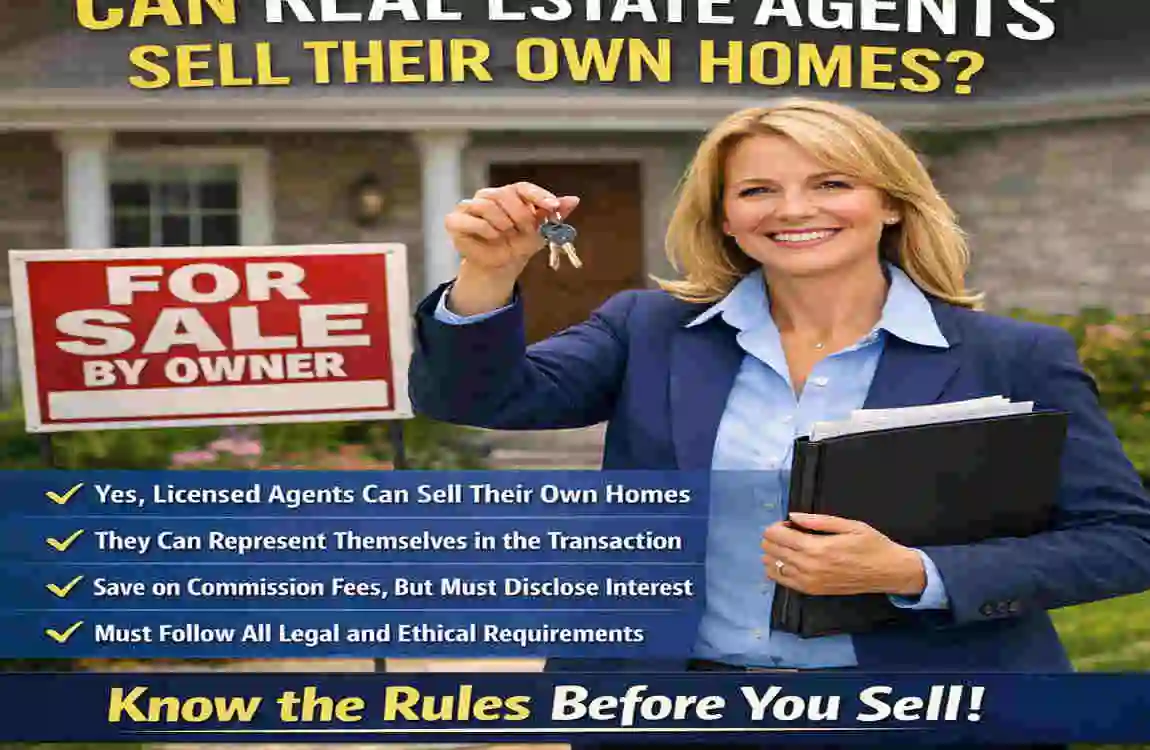
Yes, Real Estate Agents Can Sell Their Own Homes—But With Strict Rules

Let us address the most important question right away. Yes, you absolutely can sell your own home as a real estate agent.
There is no law in the United States that forces a licensed real estate professional to hire another agent to sell their personal property. You have every right to take charge of your own transaction.
However, this does not mean you can operate exactly like an average homeowner. Because you hold a professional license, you are held to a much higher standard by the law and by your local real estate boards.
The biggest rule you must follow revolves around transparency. You cannot pretend to be just an average homeowner who happens to know a lot about real estate.
According to the strict ethics codes set by organizations such as the National Association of Realtors, agents must clearly disclose their license status to anyone interested in buying the property. You have to tell the buyer, “Hey, I own this house, and I am also a licensed real estate agent.”
This rule exists to protect the buyer. It ensures they know they are negotiating against an industry professional, which levels the playing field.
Federal vs. State Regulations on Agent Self-Sales
When you sell your own house, you must navigate two different levels of rules: federal laws and state laws. Let us break these down into simple concepts.
At the federal level, you must follow the Real Estate Settlement Procedures Act (often called RESPA). Think of this as the ultimate rulebook for fair closing costs and honest dealing. You must also strictly adhere to federal fair housing laws, meaning you cannot discriminate against any potential buyer for any reason.
State laws, however, are where things get very specific and sometimes tricky. Every state has its own rules on how agents should handle property sales.
For example, in states like California, the rules are incredibly strict regarding “dual agency.” This is when one agent represents both the buyer and the seller. If you are the seller, acting as the buyer’s agent at the same time is heavily regulated and often banned to prevent conflicts of interest.
On the other hand, states like Texas tend to be more flexible, allowing you to navigate the sale with fewer restrictions as long as you provide clear, written notices to all parties involved.
Disclosure Requirements Every Agent Must Follow
If there is one word you need to remember from this entire article, it is disclosure. You must clearly and in writing reveal your identity as an agent.
You cannot just casually mention it during an open house. You need to use mandatory forms, such as a seller’s agency disclosure document. This document officially confirms your licensed status and ownership of the property.
You must include this disclosure in your local listing database (the MLS), on all your marketing flyers, and in the final purchase contract.
What happens if you forget or choose to hide this fact? The penalties for non-compliance are severe.
You could face massive financial fines from your state’s licensing board. Even worse, you could face a total license suspension. Losing your ability to work to save a few bucks on your own house is never worth the risk.
The Hidden Risks of Selling Your House as a Real Estate Agent
While keeping the commission sounds fantastic, selling your luxury house as an agent is not always a smooth ride. You will encounter hurdles that average sellers do not.
The biggest hidden risk is emotional bias. You are a professional, but this is still your home. You raised your kids here, you renovated that kitchen, and you love that weird paint color in the guest room.
When buyers come in and critique your home, it is hard not to take it personally. This emotional connection can cloud your judgment, leading you to overprice the home or to refuse perfectly reasonable offers.
Another major hurdle is the natural conflict of interest. Buyers know you want the highest price possible, but they also know you are an expert negotiator. This dynamic can make them nervous and defensive from the very first handshake.
Risks and How to Mitigate Them
To help you prepare, let us look at the top five risks you will face and how you can manage them.
- Buyer lawsuits over undisclosed details. Buyers might assume that because you are an agent, you know every single flaw in the house. If the roof leaks a month after closing, they might sue you, claiming you hid the defect.
- How to mitigate: Over-disclose everything. Hire a third-party inspector before you list the house and hand that report to every buyer.
- Slower sales due to perceived bias. Some buyers might think you are too emotionally attached and won’t negotiate fairly.
- How to mitigate: Let a neutral third party, like your managing broker, handle the final price negotiations.
- Commission conflicts. If a buyer brings their own agent, that agent expects to be paid. If you refuse to offer a buyer’s agent commission, they will not show your house to their clients.
- How to mitigate: Always offer a competitive payout to the buyer’s representative. You are still saving money on the listing side.
- Market perception. Buyers sometimes avoid “insider deals.” They might think, “If this house is so great, why didn’t another agent buy it off-market?”
- How to mitigate: Market the house beautifully to the general public, proving it is a genuine, high-quality listing.
- Tax implications on self-represented sales. The IRS treats your home sale differently if you try to claim a business deduction or commission on your own property.
- How to mitigate: Talk to a certified tax accountant before you list the home.
Recent industry data highlights these challenges. A 2025 report looking at market trends noted that poorly managed FSBO homes often sell for about 6% below market value. You must use your expertise to avoid falling into this statistic.
Real Agent Stories: Wins and Pitfalls
Let us look at some real-world examples to show you how this plays out in practice. These stories are anonymized, but the lessons are incredibly valuable.
The Win: Sarah, an agent in Ohio, decided to sell her own condo. Because she knew exactly what local buyers wanted, she spent two weeks staging the home using modern, neutral furniture. She aggressively marketed the property on social media, fully disclosing her status as an agent. Because she priced it perfectly using her insider data, she received multiple offers. She sold the condo in three days, saving over $12,000 in listing commissions.
The Pitfall: Mark, an agent in Florida, thought he could easily sell his luxury home. He was so proud of the custom pool he built that he priced the house $50,000 over the neighborhood average. He also acted as his own negotiator and got easily offended when buyers pointed out that the roof was old. The house sat on the market for six months. Eventually, a buyer sued him after closing, claiming that Mark had used his real estate license to conceal known plumbing defects. Mark spent more on legal fees than he saved on commission.
Pros of FSBO for Real Estate Agents Selling Their Own Home
Now that we have scared you a little bit with the risks, let us talk about the exciting rewards. There is a reason why so many agents choose to sell their own homes.
First and foremost, you get to leverage your incredible expertise. You are not guessing at the market value. You have direct access to the exact recent sales data in your neighborhood. You know how to take professional photos, write captivating descriptions, and run targeted online ads.
Second, the cost savings are massive. This is the biggest draw for most agents. Let us do some simple math. If you are selling a house for $300,000, a traditional 5% to 6% total commission would cost you between $15,000 and $18,000.
By acting as your own listing agent, you eliminate the listing side of that fee. Even if you pay the buyer’s agent, you’ll still keep thousands of dollars in your pocket. That is money you can use for the down payment on your next home!
Third, you gain ultimate speed and control. You do not have to wait for another agent to return your calls. You can schedule showings when they fit your life, host open houses on your own terms, and push the closing timeline as fast as you want without dual agency drama slowing you down.
Finally, let us look at a trending angle. Current 2026 market statistics show that agents who sell their own homes as FSBOs actually outperform traditional, non-licensed FSBO sellers by nearly 20% in final sale price. Your license is a superpower when used correctly.
Comparison Table: Making the Right Choice
To help you visualize your options, check out this simple breakdown.
FeatureFSBO Agent (You sell it)Hiring Another AgentTraditional FSBO (No License)
Listing Commission: You pay nothing ($0). You pay 2.5%-3%. You pay nothing ($0).
Market Knowledge High (You are an expert). High (They are an expert). Low (Guessing prices).
Disclosure Rules Strict (Must disclose status). Simple (Standard forms). Simple (Standard forms).
Emotional Control Hard (It is your home). Easy (They are neutral). Hard (It is their home).
Overall Profit: Highest potential profit. Average expected profit. Lowest (Often underpriced).
Step-by-Step Guide: Rules for Real Estate Agents Selling FSBO
If you have weighed the pros and cons and decided to leap, you need a solid game plan. You cannot just wing this process.
Follow this detailed, step-by-step guide to ensure you stay legally compliant while maximizing your final sale price.
Verify your license status and get pre-approved disclosures. Before you do anything else, check with your managing broker. Some brokerages have strict internal policies about agents selling their own homes. You might need your broker’s written permission. Next, gather all the mandatory disclosure forms for your state. Fill out the form that states you are a licensed agent selling your own property. Have these documents printed and ready before you take a single photograph of the house.
Price your house right, free of emotional bias. This is where you must put on your professional hat. Run the comparable sales (comps) just like you would for a demanding client. Look at homes that sold in the last 90 days within a one-mile radius. Do not add $10,000 to the price just because you love your backyard garden. Use your agent tools to determine the exact market value, then price it aggressively to attract multiple buyers quickly.
Market the property like a true professional. Do not cut corners here. Just because it is your own house does not mean you can use blurry smartphone photos. Hire the professional photographer you always use. Put the listing on the MLS (ensuring you check the box that says “Agent Owned”). Use clever Zillow hacks to claim the listing as the owner, but direct the contact information to your professional agent profile so you capture the leads.
Handle showings and negotiations with the utmost ethical integrity. When buyers or other agents walk through the door, you must remain incredibly professional. Hand them the disclosure forms immediately. When an offer comes in, do not let your ego get in the way. If a buyer points out that the carpets need replacing, do not get defensive. Negotiate on the facts and the numbers, keeping your emotions completely out of the room.
Navigate inspections, appraisals, and closing smoothly. When the buyer hires a home inspector, let them do their job. If the inspector finds a problem, offer fair credit or fix it promptly. When the appraiser arrives, hand them a neat folder containing your comparable sales data to support your price. Finally, work closely with the title company to ensure all your agent-owned disclosures are filed correctly in the final closing packet.
If you follow these steps, you will confidently answer the question, “Can a real estate agent sell their own home?” with a resounding, “Yes, and I did it perfectly.”
Proven House Sale Hacks for Real Estate Agents Going FSBO
You already know the basics of selling real estate. But when you are selling your own home, you want to pull out all the stops to get top dollar.
Since you are not paying a listing commission, you have a little extra budget to play with. Here are 10 highly actionable, trending house sale hacks optimized for the 2026 market that will help you crush your own listing.
Use pocket listings on your private agent networks. Before you officially list the home on the public market, utilize your professional network. Send a quiet email to the top agents in your office or your local Facebook networking groups. Let them know you have an “agent-owned, off-market exclusive” coming soon. This creates a sense of VIP exclusivity. Why it works: Agents love bringing off-market deals to their buyers. You might secure a full-price offer before you even put a sign in the yard.
Implement AI virtual staging with free or low-cost tools. If you have already moved out and the house is empty, do not leave it bare. Empty rooms look smaller in photos. Use modern artificial intelligence tools to enhance your listing photos digitally. Why it works: Buyers struggle to visualize space. Showing them a beautifully rendered living room increases online clicks dramatically, bringing more foot traffic to your open house.
Master the art of price psychology. You know the “left-digit effect,” so use it on your own house. Instead of pricing your home at a flat $300,000, price it at $299,900. Why it works: The human brain processes numbers from left to right. Even though it is only a $100 difference, the buyer’s brain categorizes the home as “200s” rather than “300s,” making it feel like a much better deal.
Capture stunning drone photos to highlight curb appeal. Hire a drone pilot to take sweeping aerial shots of your property, your neighborhood, and nearby parks. Why it works: In 2026, buyers are looking at the entire lifestyle, not just the house. Aerial photos show them the community they are buying into, which adds immense perceived value to the listing.
Offer creative buyer incentives instead of paying commissions. If you are struggling to get offers, do not immediately drop the home’s price. Instead, offer to pay $5,000 toward the buyer’s closing costs or offer to buy down their mortgage interest rate. Why it works: Buyers are often cash-strapped at closing. Giving them cash assistance feels like a massive win for them, but it protects your home’s official recorded sale price.
Build a hype-generating “Coming Soon” campaign. Do not just list the house on a random Tuesday. Create a two-week “Coming Soon” marketing blitz. Put a teaser video on your Instagram and TikTok. Why it works: You build tension and anticipation. By the time you finally open the doors on a Saturday morning, you will have a line of buyers waiting outside, which naturally drives up offers.
Create a pre-listing inspection report display. Hire an inspector before you list. Fix all the minor issues they find. Then, leave a copy of that clean inspection report right on the kitchen counter for buyers to read during showings. Why it works: It builds instant trust. Buyers feel safe knowing a professional has already checked the home, removing their fear of hidden surprises.
Leverage off-market buyer lists from your past clients. Dig into your own CRM (Customer Relationship Management) database. Email your past clients and say, “I am selling my personal home. Do you know anyone looking to move into our neighborhood?” Why it works: Word-of-mouth is powerful. Your past clients already trust you, and they will eagerly recommend your home to their friends and family members.
Time your minor repairs for maximum ROI. Do not renovate the entire kitchen; instead, change the cabinet hardware, paint the front door a bold color, and replace the old mailbox. Why it works: These micro-repairs cost less than $200 but completely change the first impression of the house. High perceived maintenance equals higher offers.
Offer a Premium home warranty. Purchase a comprehensive one-year home warranty for the buyer and prominently advertise it in your listing description. Why it works: Buyers are terrified that the furnace will break the day they move in. A $500 warranty removes that anxiety, making them much more comfortable offering your full asking price.
State-by-State Breakdown: Can Real Estate Agents Sell Their Own Homes?
As we mentioned earlier, the rules change depending on where you live. While the answer to “can a real estate agent sell their own home?” is universally yes, the how varies wildly.
State real estate commissions are very protective of consumers. They want to make sure that an everyday buyer does not get taken advantage of by a smooth-talking industry insider.
Because of this, you must check your local laws. To give you a head start, we have compiled a quick breakdown of how 10 major states handle agents selling their personal properties.
State: Are Agent Self-Sales Allowed? Specific Rules & Restrictions
New York (NY) Yes, strict dual agency laws. Advanced written consent from all parties is absolutely required.
Florida (FL) Yes Allowed with clear written consent. Very common state for agent-owned FSBOs.
California (CA) Yes Extremely strict disclosure laws. Dual agency is heavily scrutinized; proceed with high caution.
Texas (TX) Yes Highly flexible. The agent must disclose their license status in writing upfront.
Illinois (IL) Yes Agent ownership must be disclosed in all marketing and on the first line of the MLS listing.
Pennsylvania (PA) Yes Must provide a specific “Licensee’s Personal Real Estate” disclosure form to buyers.
Ohio (OH) Yes, you cannot represent the buyer of your own home in the same transaction under any circumstances.
Georgia (GA) Yes Requires written disclosure of license status in the contract before any money changes hands.
North Carolina (NC) Yes Must disclose agent status on all promotional materials, including yard signs in some counties.
Michigan (MI) Yes, simple disclosure rules, but brokers may require you to run the sale through the office.
As you can see, the recurring theme is honesty. As long as you clearly communicate who you are, you can navigate the state rules successfully.
Frequently Asked Questions (FAQs)
Selling a house as a licensed professional raises many specific questions. Here are the most common things agents and buyers ask about this unique process.
Can a real estate agent sell their own home without disclosing their license? Absolutely not. Failing to disclose that you hold an active real estate license is a massive violation of ethical codes and state laws. You must tell the buyer in writing that you are a licensed professional. Hiding this fact can lead to severe fines and the total loss of your real estate license.
What happens if I want to act as a dual agent for my own house? This is highly risky and often illegal, depending on your state. Dual agency means you represent the buyer and the seller. If you are the seller, it is impossible to be completely fair and neutral to the buyer. Most experts, and many state laws, strongly recommend against dual agency in personal sales. Always encourage the buyer to get their own representation.
What is the average time to sell an FSBO home as an agent? Because you have professional market knowledge, agent-led FSBOs usually sell much faster than traditional FSBOs. In the 2026 market, a properly priced and staged home sold by an agent typically goes under contract within 14 to 21 days, depending heavily on local demand.
Do I have to pay my broker a split if I sell my own house? This entirely depends on the independent contractor agreement you signed with your brokerage. Some generous brokers waive their fee for one personal home sale a year. Other strict brokerages require you to run the transaction through the office and pay their standard split. Check your contract before you list!
Can I put my own home on the MLS? Yes, but you usually have to run it through your brokerage, and you must check a specific box indicating that the property is “Agent Owned.” This ensures all other agents browsing the MLS know they are dealing directly with a licensed peer.