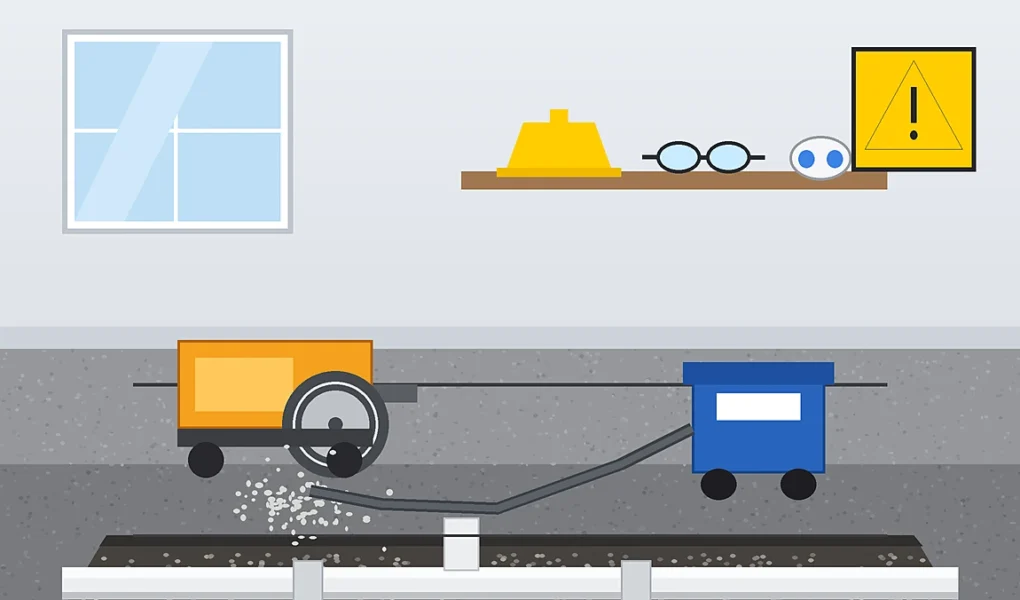
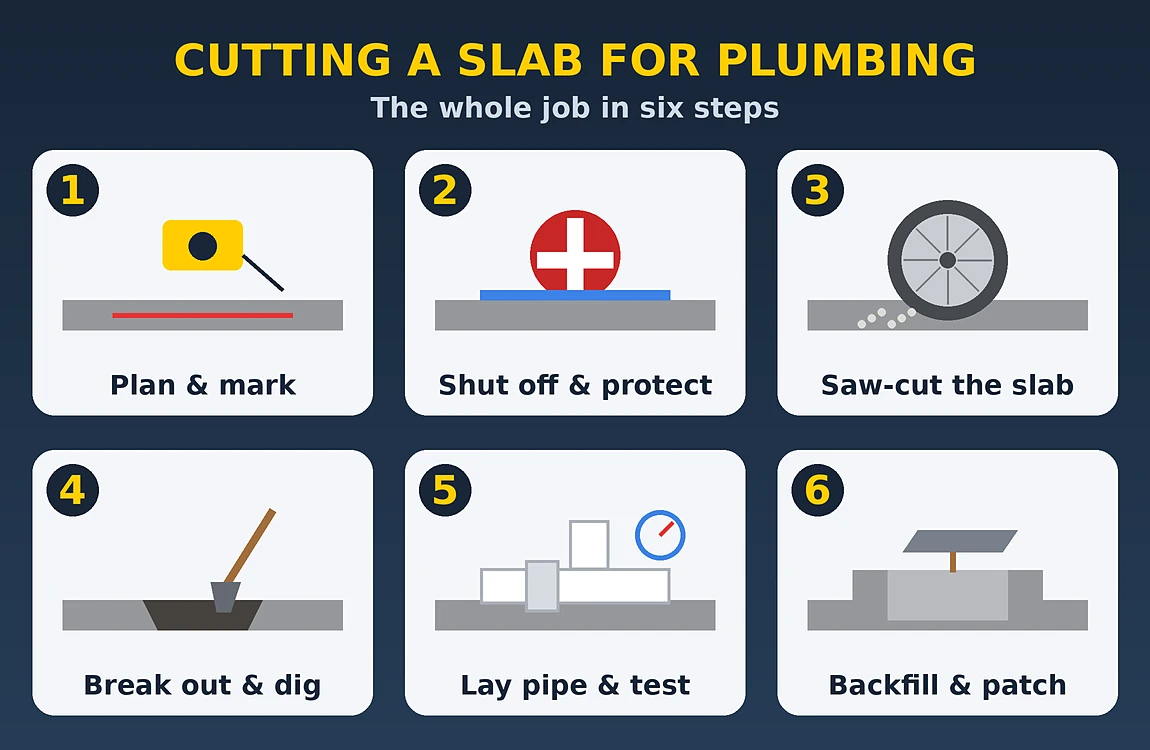
To cut a concrete slab for plumbing, locate and scan what is inside the slab, mark a narrow trench along the pipe path, cut both edges with a diamond blade and continuous water, break out the strip with an electric demolition hammer, fix and pressure-test the pipe, then backfill and patch with new concrete. Wear a respirator, eye and ear protection, and use GFCI-protected power.
The good news: this is a well-understood job. The bad news: it goes wrong in predictable ways, such as a blade through a water line, a cloud of silica dust in a closed room, or a cut through a post-tension cable. This guide walks through the whole process in order, and flags the points where calling a pro is the smarter move.
Should you cut the slab at all?
Before you rent a saw, make sure opening the slab is the right fix. There are usually three ways to reach pipes under a slab, and each trades cost against mess.
| Method | How it works | Best for | Main drawback |
|---|---|---|---|
| Break the slab | Cut a trench or opening directly above the pipe | Localized repairs and new drain or supply lines | Most disruptive to plumbing floors; needs a concrete patch |
| Tunnel under the slab | Dig a pit outside and tunnel to the leak | Keeping finished floors intact | Labor-intensive and usually costs more |
| Reroute the pipes | Abandon the old line and run new pipe through walls or the attic | Repeated leaks or aging pipe | Wall and ceiling work to repair afterward |
That comparison follows the repair options described by Servpro and Angi. If you can reach the pipe with a short, narrow trench, cutting the slab is often the most direct route. If the leak sits under cabinets, a bearing wall, or a finished floor you want to keep, tunneling or rerouting deserves a quote.
What do you need before you start?
Permits and utility checks
Drain and supply changes usually need a local plumbing permit and an inspection. Fees vary widely, and HomeGuide reports plumbing permits running from about $30 to $500, so call your building department first.
If any part of the work involves digging outside the house, such as tunneling or tying into a yard line, call 811. The U.S. Pipeline and Hazardous Materials Safety Administration states that every digging project requires a call to the one-call center, and the service is free. The national 811 site advises contacting your center a few business days before you dig. Keep in mind that utilities mark their own lines only. As CenterPoint Energy notes, private lines such as sprinkler systems and yard lights are your responsibility, so hire a private locator if you are unsure.
Scan the slab
This is the step people skip, and the one that causes most of the expensive mistakes. Angi warns that slabs may have plumbing lines running through them, and hitting one with a saw can cause major leaks and put you at risk of electrocution.
Ground-penetrating radar (GPR) is the standard non-destructive way to see rebar, conduit and other embedded objects before cutting, according to SPH Engineering. Concrete scanning services are available in most metro areas, and a scan costs far less than a burst line.
Special warning for post-tensioned slabs. Some slabs contain steel tendons that are tensioned after the concrete cures. GPRS identifies pipe damaging those tendons as the primary risk of sawing these slabs, and CMC says you must know the cable location and depth before drilling, cutting or coring. If your home might have a post-tensioned slab, check the original plans and talk to a structural engineer before you cut anything.
Tools and gear
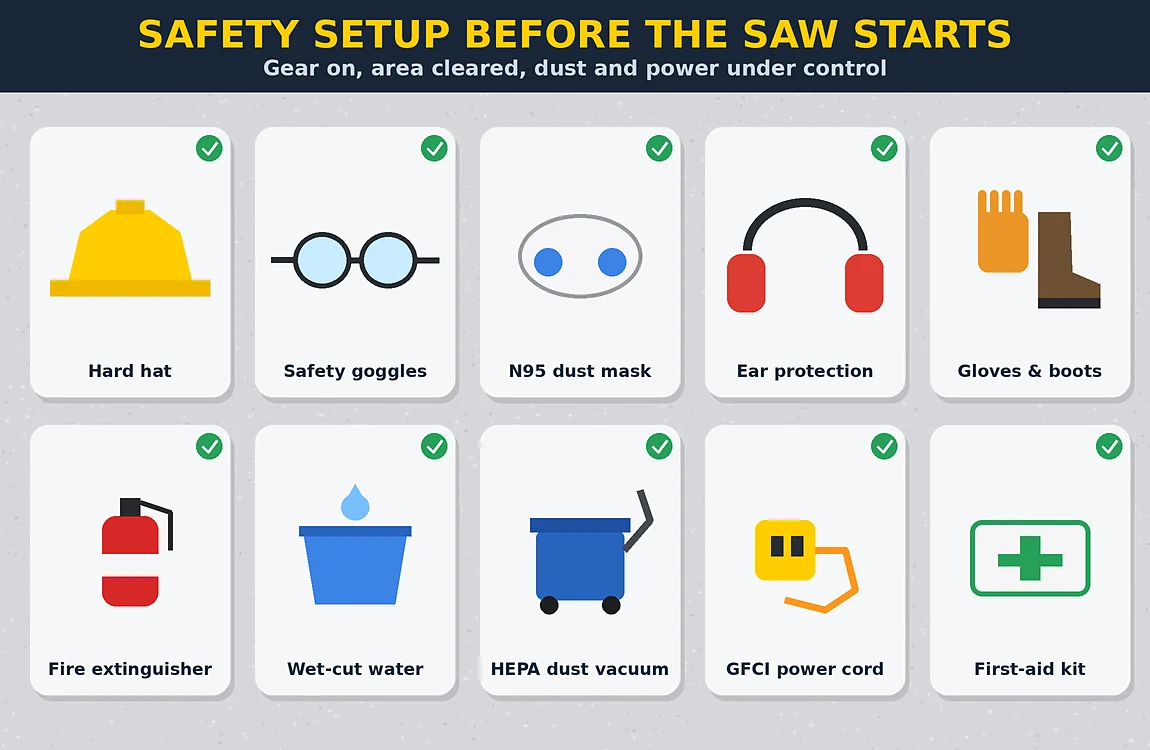
- Wet-cutting concrete saw (walk-behind or handheld) with a diamond blade and water feed
- Electric demolition hammer with a pointed bit and a flat chisel bit
- Angle grinder with a diamond blade for tight corners
- Chalk line, tape measure and a marker
- Wet/dry vacuum with a HEPA filter for slurry and debris
- Heavy-duty extension cord with a GFCI
- Safety glasses, hearing protection, gloves, steel-toe boots and a respirator
Saw depth matters. Bob Vila notes that a 7-inch circular saw cuts only about 2-1/4 inches deep, while a 14-inch wet-cutting blade on a concrete saw reaches about 4-5/8 inches. A deeper cut means a cleaner break, so renting the larger saw is usually worth it.
How do you cut the slab, step by step?
Mark the trench
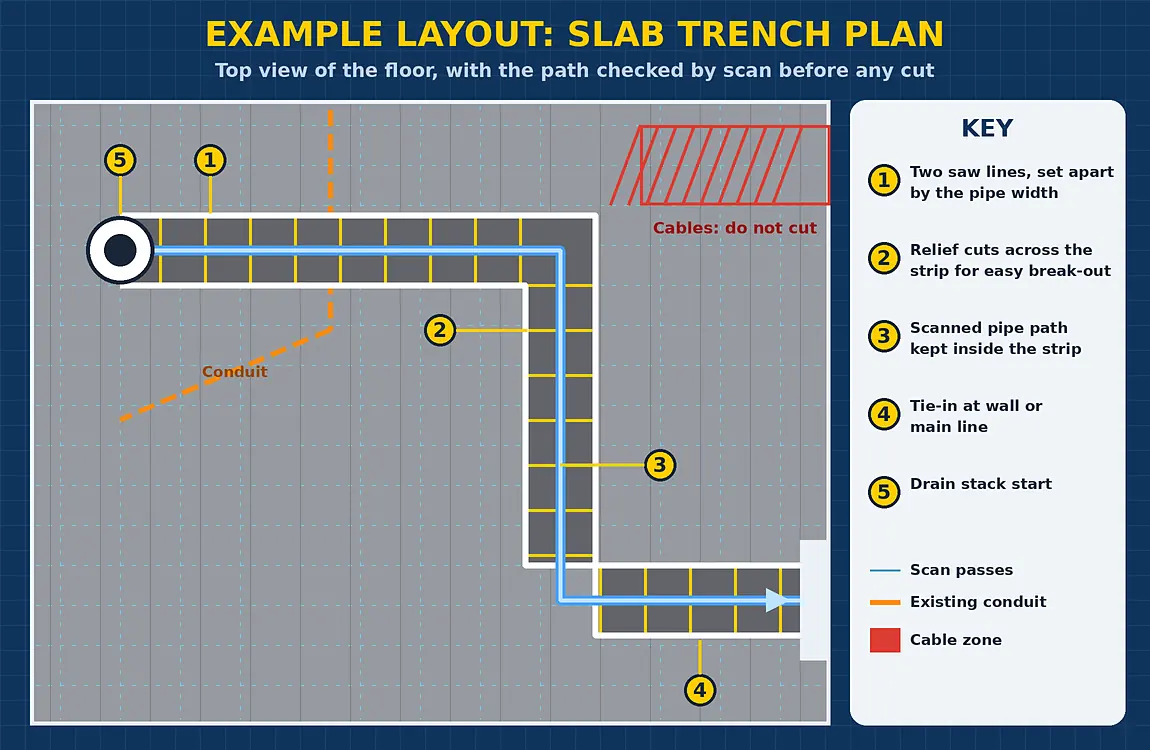
Follow the scanned pipe path and snap two parallel chalk lines. Keep the trench only as wide as the pipe, the fittings and your hands need. A narrower cut means less concrete to break out and less to patch. Mark where the trench meets walls, and note any rebar or mesh the scan found.
Cut both lines wet
Make your first pass shallow, which helps keep the blade from wandering. Then repeat in progressively deeper passes until you reach the saw’s maximum depth or the bottom of the slab. This approach matches the multi-pass technique described by Natural Handyman. Do not lean on the saw; let the diamonds do the work.
Water is not optional. OSHA’s silica standard for construction lists wet cutting with a continuous water feed as a specified control method, and its construction standard guide explains how Table 1 pairs common tasks with dust controls. Cutting indoors adds a wrinkle. OSHA’s walk-behind saw fact sheet says wet methods alone may not reliably keep exposure low in enclosed areas, so extra ventilation may be needed, and wet slurry should be cleaned up before it dries, using a shovel or a HEPA-filtered vacuum.
For electrical safety, use GFCI protection and watertight connectors on every cord, as OSHA’s silica control fact sheet for core saws and drills recommends for tools used with water.
Add relief cuts and break out the strip
Between your two long cuts, make a few crosswise relief cuts so the strip breaks into small pieces. Then use the electric demolition hammer, starting in the middle of the strip and working toward the saw lines. Angled strikes often work better than straight-down ones.
When you get close to the pipe, switch to hand tools. Do not swing a hammer or run the breaker directly over a known pipe. Chip carefully around it, and stop if you find anything the scan did not show.
Reach, repair and test the pipe
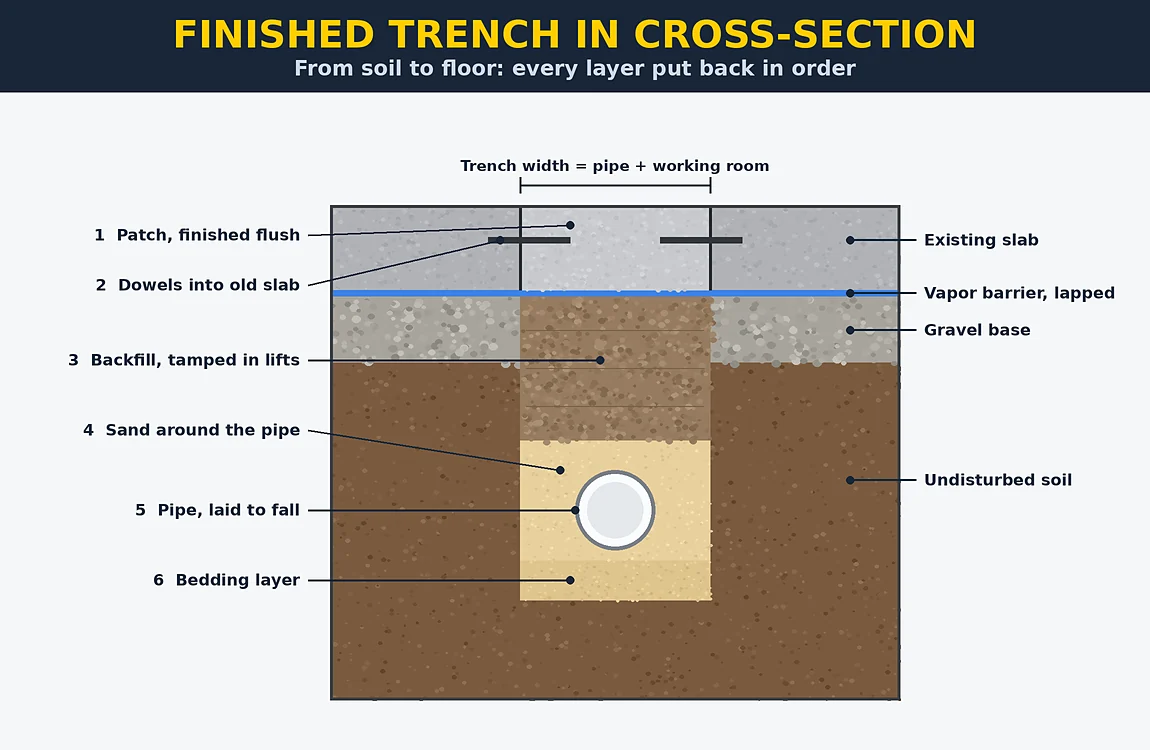
Dig out the soil or fill to the depth the repair needs. Make your fix or install the new pipe line with the correct fittings for your pipe material and local code. Then pressure-test or water-test the line, and have the inspector see it if your permit calls for that. This is the cheapest moment to find a bad joint.
Bed the pipe, backfill and patch
Set the pipe on a clean sand bed, backfill in layers and compact each one. Clean out the cut edges, and tie in rebar or dowels if your plumber or engineer recommends it so the patch bonds to the old slab. Pour concrete that matches the original slab, finish it level with the surrounding floor, and keep it damp while it cures. Ask your concrete supplier or a structural pro about the right mix and cure time for your slab.
How much does it cost?
Costs depend on slab thickness, access, local labor rates and what is under the floor. These are published U.S. ranges, not quotes for your house:
- Breaking the slab to reach a pipe: about $500 to $3,000, according to Fixr.
- Under-slab plumbing repair: $500 to $4,000, per This Old House.
- Rerouting plumbing: $1,500 to $15,000 and full slab replacement $3,600 to $8,000, per the same This Old House breakdown, which draws on HomeAdvisor data.
- Leak detection alone: $150 to $600, also per This Old House.
For a broader average, HomeAdvisor puts typical slab leak repair at around $2,280, with a range of $630 to $4,400. Tunneling can run higher because of the excavation and patch work, as Angi explains.
When should you hire a pro instead?
Call a licensed plumber or professional concrete cutter if any of these apply:
- You cannot confirm what is inside the slab, or a scan shows tendons you cannot identify.
- The cut is near a load-bearing wall, a column or a footing.
- You must work indoors in a tight space with little ventilation.
- The slab is thick and you do not have access to a large saw and hammer.
- Your local code requires a licensed plumber to do the pipe work.
Frequently asked questions
Can I cut a concrete slab for plumbing myself?
A short, well-scanned trench is a realistic project for an experienced DIYer. But if you cannot verify what is in the slab, or the layout is complex, hire a licensed plumber or concrete cutter. A single nicked line or cable costs far more than the labor you would save.
What is the best tool for cutting a concrete slab?
A wet-cutting saw with a diamond blade makes the cleanest cuts, and an electric demolition hammer removes the concrete between them. A circular saw can work for shallow cuts, but it cannot reach full depth in most slabs.
How deep should I cut?
Cut as deep as your saw allows, up to the full slab thickness, then break out the rest. Slab thickness varies by house, so measure it at an edge or a core hole if you can.
Do I need a permit?
In most places, yes, for drain or supply changes. Rules differ by city and county, so ask your building department before you start.
Is cutting concrete dangerous for my lungs?
It can be. Cutting concrete releases respirable crystalline silica, which OSHA says can irreversibly damage the lungs when inhaled over time (OSHA). Cut wet, ventilate, wear a proper respirator indoors, and clean slurry up before it dries.
How long does the job take?
Marking, cutting and breaking out a short trench often fits in a day. Pipe work, inspection, patching and curing add more time, so plan on a couple of days before the floor is usable again.
Final thoughts
Cutting a slab for plumbing is less about brute force than about preparation. Scan first, cut wet, test before you pour, and keep the trench as small as the job allows. Do those four things and the rest is a matter of patience, and a good concrete patch is rarely noticeable once the new flooring goes down.
Sources
- U.S. Occupational Safety and Health Administration (OSHA), OSHA’s Respirable Crystalline Silica Standard for Construction
- OSHA, Control of Silica Dust in Construction: Walk-Behind Saws
- OSHA, Control of Silica Dust in Construction: Rig-Mounted Core Saws or Drills
- U.S. Pipeline and Hazardous Materials Safety Administration (PHMSA), Call Before You Dig
- 811, Before You Dig
- CenterPoint Energy, Call 811 Before You Dig
- This Old House, Slab Leak Repair Cost
- HomeAdvisor, How Much Does Slab Leak Repair Cost?
- Angi, How to Cut Concrete
- Angi, How to Fix a Slab Leak
- Bob Vila, How to Cut Concrete
- HomeGuide, Slab Leak Repair Cost
- Fixr, How Much Does It Cost to Repair a Slab Leak?
- GPRS, How to Safely Saw or Drill into Concrete in Post-Tensioned Slabs
- CMC, The Importance of Understanding the Depth of Post-Tensioned Cables
- SPH Engineering, Ground-Penetrating Radar (GPR) for Concrete Scanning
- Servpro, Slab Leak Repair
- Natural Handyman, Tool Rentals: Cutting a Trench in Concrete