Picture this relatable scenario: You wake up early, ready to tackle the day. You step into the shower, turn the knob, and instead of a powerful, refreshing stream of water, you get a sad, sputtering trickle. Or perhaps you are trying to wash dishes, and the water pressure drops to a mere drip the moment someone flushes a toilet downstairs. If you live in a multi-story home, a rural area, or a house with an ageing plumbing system, this frustrating situation might be a daily reality.
Frequent water outages and low water pressure are more than just minor annoyances. They disrupt your routine, make basic household chores take twice as long, and can even damage your water-dependent appliances over time. As utility costs continue to climb globally, taking control of your own home’s water system has never been more important.
This brings us to a crucial home improvement skill. Learning how to install a water pump for house applications is a game-changer for modern homeowners. Why should you learn this skill? For starters, it offers incredible self-reliance. You will no longer be at the mercy of municipal water fluctuations or an ageing neighbourhood infrastructure.
Furthermore, the financial benefits are massive. Hiring a professional plumber or well technician to install a pump can cost anywhere from $500 to $2,000 labourin labour alone. By taking the DIY route, you keep that money right in your pocket. You also gain a deep, valuable understanding of how your home operates, making future maintenance a breeze.
Why install a Water Pump in Your House?

You might be wondering if a water pump is truly necessary for your specific living situation. Let us break down the common triggers that send homeowners running to the hardware store to upgrade their pump.
Private Well Water Systems
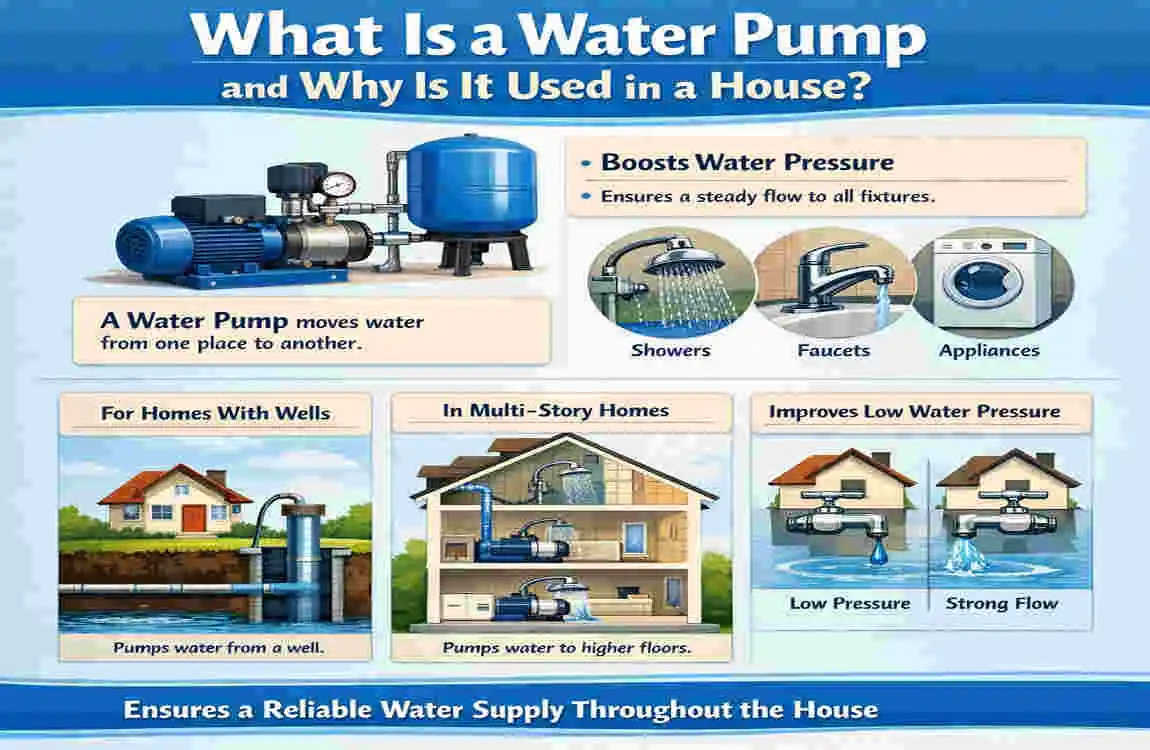
If you live in a rural or semi-rural area, you likely get your water from a private well rather than a city supply. A well relies entirely on a mechanical pump to pull water from deep underground and push it into your u. If your current pump is failing, old, or simply not powerful enough to keep up with your growing family’s demands, installing a new, highly efficient home well pump is essential.
Multi-Story Home Challenges
Even if you are connected to a city water supply, you may still experience low pressure. City water lines are only pressurised to a certain degree. If you live in a tall, multi-story house, gravity fights against that pressure. By the time the water reaches your third-floor main bathroom, it might barely have the strength to flow out of the showerhead. In this case, a specialised booster pump acts as a middleman, drawing city water and forcefully pushing it up to the higher floors.
Rainwater Harvesting and Eco-Friendly Systems
As more families look toward sustainable living, rainwater harvesting has become incredibly popular. You collect rainwater in large barrels or cisterns, but how do you get that water from the barrel in your yard to the garden hose or your indoor toilets? You guessed it—you need a dedicated water pump to pressurise that standing water and move it where it needs to go.
Impressive Return on Investment
Beyond just comfort, let us talk about energy efficiency. Modern water pumps are far more advanced than those from just 10 years ago. They use less electricity to move more water. Because of these energy-efficiency trends, a brand-new pump will often pay for itself in just 2 to 3 years through significantly lower monthly electricity bills. That is a fantastic return on investment for any homeowner.
Types of Water Pumps for Home Use
Before you can learn how to install a water pump for house systems, you need to buy the right one. Not all water pumps are created equal. Buying the wrong type of pump is like buying a tractor to commute on the highway—it just will not work well. Let us look at the three main types of pumps you will encounter.
Submersible Pumps
As the name suggests, submersible pumps are designed to be completely dropped underwater, usually deep inside a well casing. Because they are completely submerged, they never have to “pull” water up; they only have to push it up. This makes them incredibly energy efficient and powerful.
They are also virtually silent because the earth and water muffle any motor noise. If your home has a deep well (anything over 25 feet deep), a submersible pump is absolutely your best choice. The only downside is that pulling them up for repairs requires some heavy lifting.
Jet Pumps
Jet pumps sit above ground, usually in a basement, a well house, or right next to the wellhead. They operate by drawing water up from the well using suction, much like you drinking through a straw.
Because physics limits how far you can suck water up, jet pumps are typically reserved for shallow wells that are less than 25 feet deep. They are very affordable and incredibly easy to access for a DIY water pump setup. Still, they tend to be slightly noisier and less energy-efficient than submersible models.
Booster Pumps
Booster pumps do not pull water from a well at all. Instead, they tie directly into your existing municipal water line. Think of them as a turbocharger for your city water. They take the incoming water, run it through an impeller, and boost the pressure before sending it throughout your large house. They are perfect for homes with multiple bathrooms or sprawling floor plans.
Here is a handy comparison table to help you decide at a glance:
Pump Type Best For Depth Capacity Cost Range Pros Cons
Submersible Deep wells (>25 ft) 100-400 ft $200-800 Efficient, low noise Harder DIY install
Jet Shallow wells (<25 ft) 5-25 ft $100-400 Easy access Noisier, less efficient
Booster city water boost N/A $150-500 Quick install Power-dependent
Tools and Materials Checklist
A successful installation comes down to preparation. There is nothing more frustrating than having your water shut off, only to realise you are missing a vital tool and have to drive to the hardware store.
To keep your project flowing smoothly, you need a dedicated arsenal of tools. You will be dealing with heavy metal, tough plastics, and electrical wiring.
Here is a bulleted list of the absolute essentials you must gather before you begin:
- Heavy-duty pipe wrenches (You will want two: one to hold the pipe, and one to turn the fitting).
- High-quality Teflon tape (To seal threaded connections and prevent leaks).
- PVC pipes and heavy-duty fittings (Ensure they match the diameter of your pump’s intake and discharge ports).
- PVC primer and cement (For permanently glueing plastic pipes together).
- A new pressure switch and pressure gauge (If your pump does not come with them pre-installed).
- A sturdy check valve and a foot valve (Crucial for keeping water in the pipes so the pump does not run dry).
- Electrical wire, wire strippers, and wire nuts (Ensure the wire gauge matches your circuit breaker requirements).
If you are setting this up inside your house, specifically in a basement or utility room, you will also want mounting brackets or a thick rubber mat. This isolates the pump from your floor, preventing annoying vibrations from echoing through your home.
Below is a quick downloadable checklist table you can screenshot and take to the store with you:
CategoryItem NeededChecked?
Tools: pipe wrenches, wire strippers, screwdrivers, hacksaw.
Plumbing PVC pipe, check valve, foot valve, Teflon tape, PVC glue .
Electrical 12-gauge or 10-gauge wire, wire nuts, electrical tape .
Hardware : mounting bolts, rubber vibration pads, pressure gauge .
Safety Precautions Before Starting
Before we dive into the steps on how to install a water pump for house applications, we must have a serious conversation about safety.
You are about to mix two things that absolutely hate each other: water and electricity. This is not a project where you can cut corners. One wrong move with a live wire and a puddle of water can lead to severe injury or worse.
First and foremost, address the electrical hazards. Go to your home’s main electrical panel and turn off the power to the circuit you will be working on. Do not just trust the breaker box labels; use a non-contact voltage tester on the wires to confirm the power is truly off. Once the power is off, put a piece of tape over the breaker so nobody accidentally flips it back on while you are working.
Next, handle the water. Shut off the main water supply valve to your house. Open up the lowest faucet in your home—usually a basement sink or an outdoor hose bib—to completely drain the existing lines. You want the pipes as empty as possible so you are not fighting a flood while glueing fittings.
Always wear your Personal Protective Equipment (PPE). This means safety glasses to protect your eyes from splashes of PVC primer, and thick work gloves to protect your hands from sharp pipe edges and wrenches that might slip.
Finally, a quick legal note for homeowners. In some cities and counties, modifying your home’s main plumbing or electrical system requires a permit and an inspection. A quick call to your local building department will clarify your local laws. It is always better to be safe and code-compliant than to face hefty fines down the road.
Step-by-Step Installation Guide
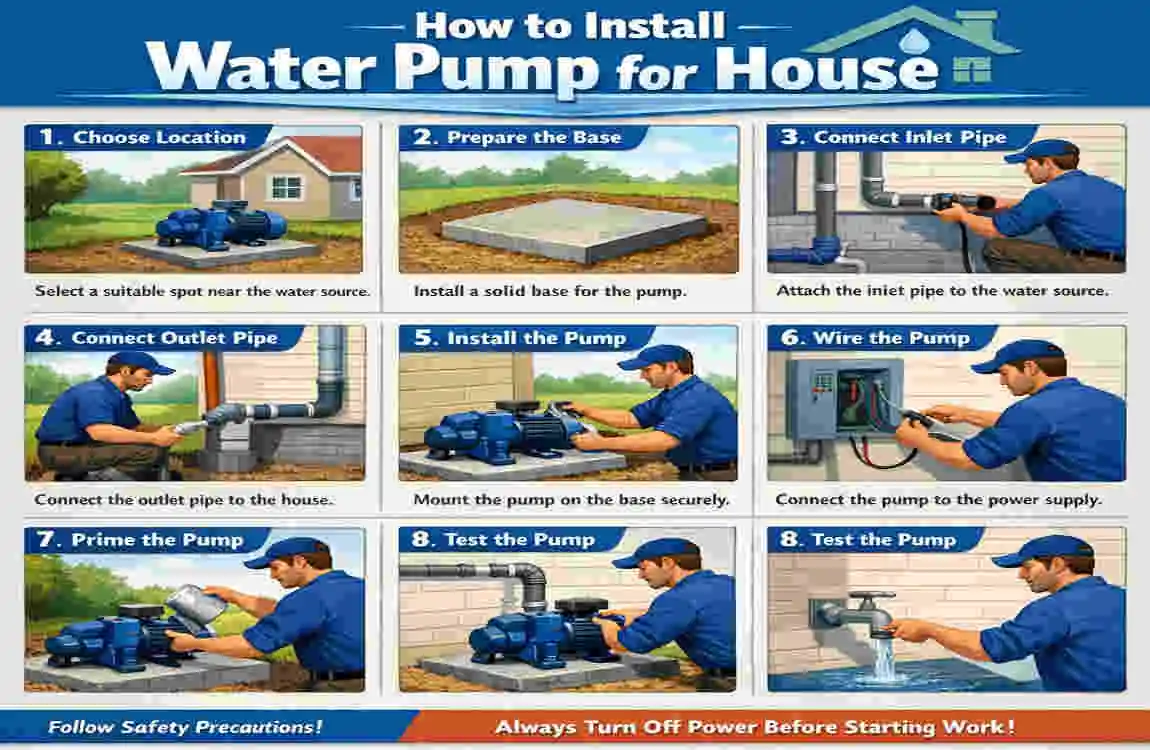
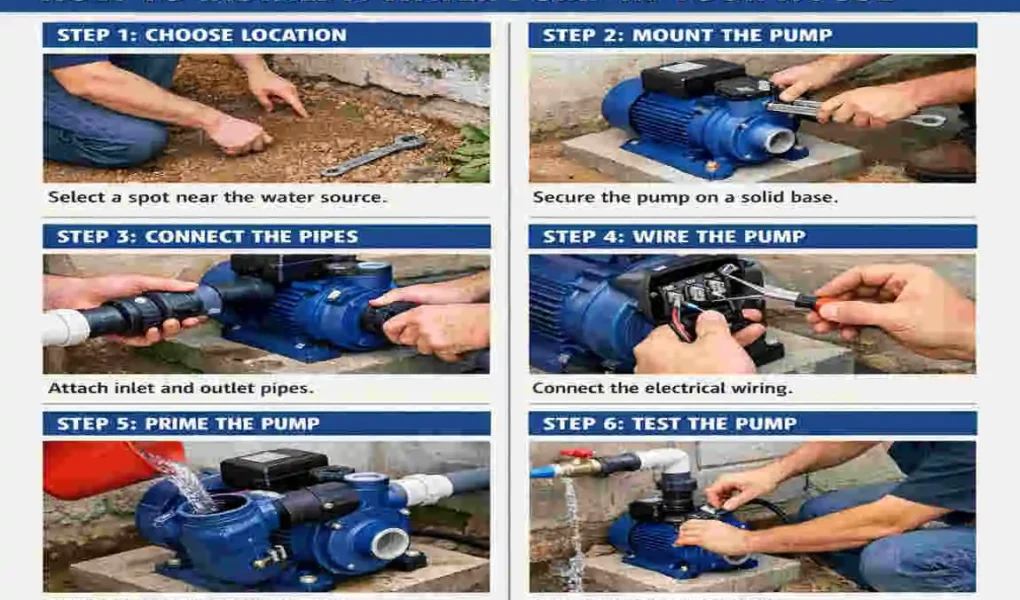
Now that you are prepped, protected, and ready with your tools, it is time for the main event. We have broken this process down into six highly detailed, understandable segments. Take your time, read through each step carefully, and do not rush.
Choose and Prepare Your Pump Location
The very first thing you need to do is decide exactly where this pump will live. If you are installing a jet pump or a booster pump, you want it in a location that is accessible, dry, and protected from freezing temperatures. A basement, a dedicated utility room, or an insulated wellhead house are your best options.
You cannot just place the pump directly on a dirt floor or uneven concrete. You need to create a stable, level base. If you are in a basement, consider building a small wooden platform or buying a pre-made equipment pad.
Assemble the Pump and Piping
Now we move on to the plumbing assembly. This is where your pipes, valves, and glue come into play.
Start by identifying the intake side (where water enters) and the discharge side (where water leaves your house). At the very end of your intake pipe—the part that drops down into the well—you absolutely must install a foot valve. This is a one-way valve that lets water flow up into the pipe but stops it from draining back down into the well when the pump turns off.
Closer to the pump itself, you will need to install a check valve. This does a similar job, keeping water pressure locked in your house’s plumbing so the pump doesn’t have to restart from scratch every time you flush a toilet.
When connecting your PVC pipes, precision is key. Cut your pipes straight using a hacksaw or pipe cutters. Use a deburring tool or sandpaper to smooth the rough edges.
Apply a coat of purple PVC primer to the outside of the pipe and the inside of the fitting. This primer literally softens the plastic. Immediately follow up with your PVC cement, push the pipe into the fitting, and give it a quarter-turn. Hold it tight for about 30 seconds. That quarter-turn ensures the glue spreads evenly, creating a watertight weld that will last for decades.
Wire the Pump Electrically
This step intimidates many people, but if you break the complex ideas into simple segments, it is very manageable.
First, determine the voltage of your pump. Most heavy-duty residential water pumps run on 240V, while some smaller booster pumps might run on standard 120V. You must ensure the circuit breaker in your electrical panel matches the pump’s requirements.
Locate the pressure switch on your pump. This is the mechanical brain of the operation. It senses the water pressure and tells the pump motor when to kick on and when to shut off.
Remove the pressure switch cover. Inside, you will typically see four main screw terminals and a green grounding screw.
- Take the electrical wire coming directly from your home’s breaker panel. Strip the casing back.
- Connect the two “hot” wires (usually black and red, or black and white depending on your wiring) to the two outside terminals marked “Line” or “L1/L2”.
- Connect the wires leading into the pump motor to the inside terminals marked “Load” or “T1/T2”.
- Crucially, secure your bare copper or green wire tightly to the green grounding screw. Grounding is non-negotiable—it is what saves your life if there is an electrical short.
Once the wires are tightly screwed down and tug-tested, replace the cover of the pressure switch.
Mount and Prime the Pump
With the plumbing roughly assembled and the wiring in place, you need to secure the pump physically. Do not leave it sitting loose! When a powerful motor kicks on, the torque will cause it to jump and vibrate. Over time, this vibration will literally rattle your PVC pipes until they crack and flood your house.
Use heavy-duty lag bolts to secure the pump’s metal feet to your wooden platform or concrete floor. Slide those thick rubber mounting pads under the feet before you tighten the bolts to absorb the noise.
Now comes one of the most critical steps in the entire guide: Priming the pump.
You can never, ever turn on a water pump when it is completely dry. The internal parts spin at thousands of revolutions per minute. Without water to lubricate and cool them, the friction will melt the plastic impellers and burn out the motor in less than five minutes.
To prime the pump, locate the priming plug on the top of the pump casing. Remove the plug with a wrench. Insert a funnel and begin pouring clean water directly into the pump casing. Keep pouring until the pump and the suction pipe are full and water overflows from the hole. Wrap the plug with Teflon tape and screw it back into place tightly. Your pump is now ready to move water safely.
Connect to House Plumbing
Now you need to bridge the gap between your newly assembled pump setup and your home’s actual main water line.
Take the discharge pipe coming out of the top of your pump and route it toward your main house line. Before you make the final connection, you must incorporate a pressure tank.
The pressure tank is a large metal cylinder that sits next to your pump. Inside is a heavy rubber bladder filled with compressed air. The pump pushes water into this tank, compressing the air. When you turn on a faucet upstairs, the compressed air forcefully pushes the water out of the tank and through your pipes. This means your pump doesn’t have to turn on every time you wash your hands—it only turns on when the tank runs out.
Connect the pump to the pressure tank, and then connect the tank’s output to your house’s main plumbing line. Depending on your home, you might be connecting to copper pipes, PEX tubing, or more PVC. Use appropriate transition fittings (such as SharkBite push-to-connect fittings or threaded adapters) to create a secure connection between the two systems.
Test and Troubleshoot
You have worked hard. The pipes are glued, the wires are tight, and the pump is bolted down and primed. It is time for the moment of truth.
Walk back to your main electrical panel and flip the breaker on. Listen closely. You should hear a solid, reassuring click from the pressure switch, followed by the smooth hum of the pump motor as it comes to life.
Stand near the pump and watch the pressure gauge. You should see the needle start to climb steadily. For a standard house, you want the gauge to stop somewhere between 40 and 60 PSI (Pounds per Square Inch). Once it hits that upper limit, the pressure switch should automatically cut the power, and the pump will turn off.
Now, grab a flashlight and inspect every single joint, fitting, and thread you touched today. Run your bare hands under the pipes to feel for any tiny droplets of water. If you spot a leak, do not panic. Turn off the power, drain the pressure, and tighten the threaded connection or reseal the PVC joint.
Finally, walk through your house and open every faucet, starting on the bottom floor and working your way up. You will likely hear a lot of hissing and sputtering as trapped air is forced out of the lines. Let the water run for a few minutes until it is clear and steady. Congratulations, you have completed a DIY water pump setup!
Common Mistakes to Avoid
Even the most enthusiastic DIYers can stumble. When you are learning to install a water pump for house systems, a minor oversight can lead to a major headache. Here are the most frequent pitfalls and exactly how to sidestep them.
First up is skipping the priming process. We touched on this earlier, but it bears repeating. In the excitement of finishing the wiring, many people flip the power on immediately to see if it works. Running a pump dry is the fastest way to destroy it. Always fill that casing with water first.
Another major mistake is using the wrong wire gauge. Your pump draws a massive surge of electricity right when it starts up. If you use a thin, undersized electrical wire, the wire will literally heat up, melt its insulation, and potentially start a wall fire. Always consult your pump’s manual and use the manufacturer’s recommended thick, heavy-gauge wire.
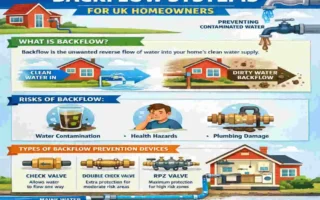
Lastly, ignoring backflow prevention is a costly error. If you forget to install a check valve, every time the pump turns off, all the water in your house will drain backwards through the pump and back into the well. Your pump will then turn on again immediately to replace the lost water. This leads to an endless, rapid on-and-off cycle called “short cycling” that will burn out the motor in weeks.
Review this quick table of errors so you know exactly what to watch out for:
MistakeConsequenceFix
No priming, motor. overheating. . Fill the pump with water before starting.
Undersized pump, low water pressure. Match the pump’s GPM (Gallons Per Minute) to house needs..
Poor thread sealing, constant leaks/waste. Always use double-wrapped Teflon tape on all threads.
Missing check valve, Rapid short cycling. install a brass check valve on the intake side
Maintenance Tips for Longevity

You have invested your time and money into this project, so you naturally want your new pump to last as long as possible. A well-maintained home well pump can easily last for 10 to 15 years. The key is setting up a simple annual maintenance routine.
Once a year, usually in the spring, head down to your pump and do a visual inspection. Turn off the power and check the pressure switch contacts. Over time, the electrical sparking can cause carbon buildup on these little metal contacts. If they look black or pitted, gently rub them with fine sandpaper until they are shiny again.
Next, test the air pressure in your pressure tank. Turn off the pump, drain the water from the water pipes, and use a standard tyre pressure gauge on the air valve at the top of the tank. The air pressure should be exactly 2 PSI lower than your pump’s turn-on pressure (for example, if your pump kicks on at 40 PSI, your tank should have 38 PSI of air). Add or release air as needed using a bicycle pump.
If your pump is located in an unheated garage or a well house outside, you must winterise it before the first freeze. Wrap the pump casing and the exposed pipes in heavy-duty foam insulation or heat tape. Water expands when it turns to ice, and a frozen pump casing will crack straight down the middle, ruining the entire unit.
Lastly, keep the area around the motor clean. Sweep away dust, cobwebs, and debris. The motor needs to breathe to keep its internal temperatures down.
When to Call a Professional
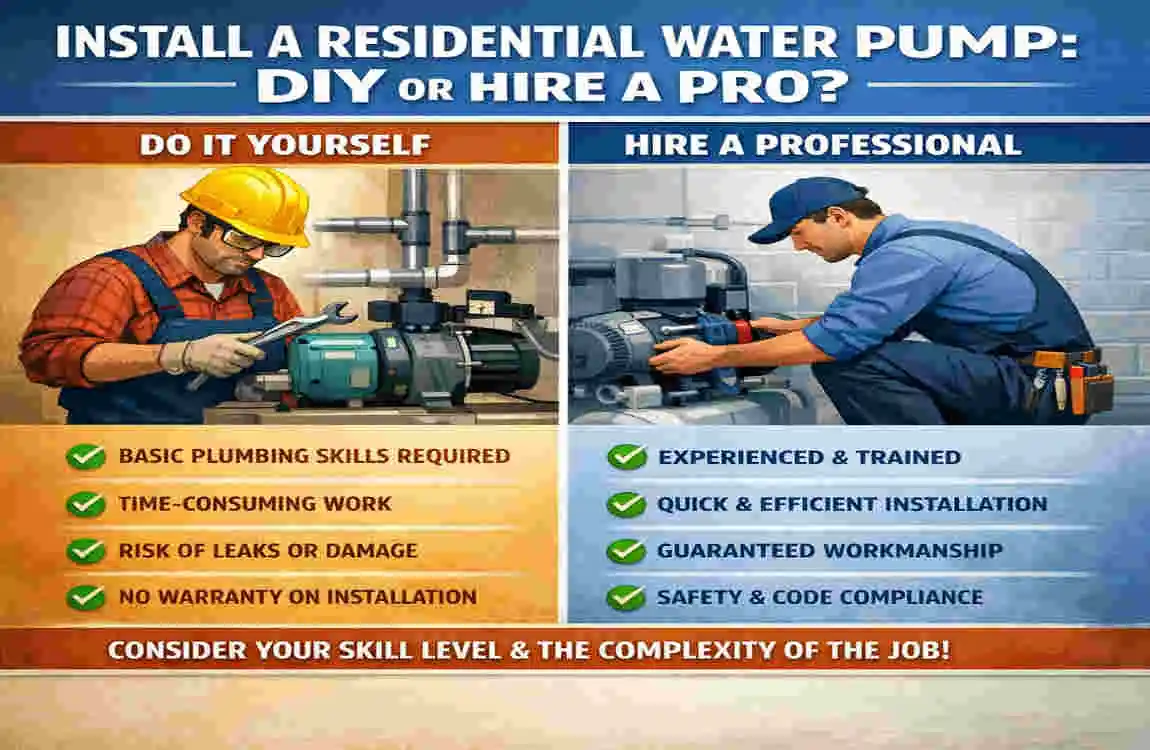
We strongly believe in the power of DIY, but part of being a smart homeowner is knowing your absolute limits. There is no shame in calling in a professional if a project moves out of your comfort zone.
You should definitely call a professional if you are dealing with complex electrical wiring. If you open your breaker box and the wires look chaotic, outdated, or you do not feel confident mapping out a dedicated 240V circuit safely, hire an electrician. A few hundred dollars in labour is well worth the cost of preventing an electrical fire.
Furthermore, if you are replacing a submersible pump in a well that is over 100 feet deep, call a well technician. Pulling hundreds of feet of water-filled water pipe and a heavy steel pump up a narrow shaft requires specialised winches and cranes. Trying to do it by hand with your buddies is a recipe for a severe back injury.
Do a quick cost-benefit analysis. If learning the skill, buying the special tools, and taking the safety risks outweigh the $500 installation fee, make the call to a local pro.
FAQs
As we wrap up our guide on how to install a water pump for house plumbing, let us answer some of the most common questions homeowners ask before taking on this project.
Can I install a water pump myself? Absolutely! If you have a basic understanding of plumbing, are comfortable safely turning off electricity, and can follow step-by-step instructions, a DIY water pump setup is well within the reach of a determined homeowner.
How long does a home water pump installation take? For a standard above-ground jet pump or a municipal booster pump, a prepared DIYer can expect the project to take anywhere from 4 to 6 hours. If you are running completely new electrical wires or digging trenches for new pipes, expect it to take a full weekend.
Do I need a permit for a home well pump? This heavily depends on your local municipality. Many rural areas allow homeowners to replace existing equipment without a permit. However, if you live in a stricter city zone and are tapping into municipal supply lines for a booster pump, you will likely need a plumbing permit. Always call your local code office to verify.
What size water pump do I need for a 3-bedroom house? Sizing is critical. For an average 3-bedroom, 2-bathroom home, you generally want a pump that can deliver between 8 and 12 Gallons Per Minute (GPM). A 1/2- or 3/4-Horsepower (HP) pump is usually sufficient to maintain excellent water pressure while running a shower and a washing machine simultaneously.
Why is my new water pump so noisy? If your new pump sounds like a jet engine taking off, you likely have a vibration issue. Ensure the pump is bolted tightly to the floor and is sitting on thick rubber vibration pads. Also, check your plumbing lines: if your PVC pipes are secured directly to your wooden floor joists without foam padding, the pipes will transmit the motor noise throughout your house.
How often should I replace my house water pump? With proper annual maintenance, high-quality water pumps should last between 10 and 15 years. Submersible pumps tend to last on the higher end of that spectrum because they are protected from the elements underwater.