Buying a home is one of the biggest financial decisions most people ever make. It affects your money, your legal rights, your future plans, and sometimes even your marriage itself. That is why the question “Can a spouse buy a house without the other in Texas?” comes up so often.
The short answer is yes, sometimes a spouse can buy a house alone in Texas. But the real answer is more complicated. It depends on where the money comes from, how the property is titled, whether the home is a homestead, and what the lender requires. In Texas, marriage and property law work together in ways that can surprise people.
This matters for many kinds of buyers. Maybe one spouse wants to invest in a rental property. Maybe a married person wants to buy a second home. Or maybe one spouse has stronger credit and wants to handle the mortgage alone. All of these situations can be possible, but they can also create legal and financial risks if they are not handled correctly.
| Question | Texas‑Specific Rule | Practical Takeaway |
|---|---|---|
| Can a married person legally buy a house in Texas without their spouse’s name on the deed? | Yes; Texas law allows one spouse to apply for a mortgage and take title alone, but property acquired during marriage is presumed community property regardless of whose name is on the deed. | Name alone on title doesn’t mean full separate‑property rights; courts usually treat it as shared if bought during marriage. |
| Does the buying spouse need the other spouse’s consent to apply for the mortgage? | No formal spousal “consent” is required for the loan application, but lenders may still ask about marital status and debts under Texas community‑property rules. | Hiding the purchase can create financial and legal risks later, especially if the loan defaults or a divorce occurs. |
| Can the non‑buying spouse claim an interest in the house later? | Yes; Texas presumes the home is community property unless the buyer proves the purchase was made with separate property (e.g., inheritance or pre‑marital funds) by clear and convincing evidence. | Keeping detailed records (bank statements, gift letters, etc.) is critical to support a separate‑property claim. |
Understanding Marital Property Laws in Texas

Texas is a community property state, and that matters a lot when one spouse tries to buy real estate alone. In simple terms, Texas law assumes that property acquired during marriage belongs to both spouses in some way, unless it clearly qualifies as separate property.
That does not mean every asset must always be in both names. It means the source of the money, the timing of the purchase, and the purpose of the property all play a major role in deciding ownership.
If you are married and planning to buy a house alone, the first thing you should understand is how Texas divides property into community property and separate property.
Community Property
Community property usually includes most assets and income earned during the marriage. That means if one spouse earns a paycheck during the marriage, that income is generally community property. If that income is used to buy a home, the home may also be considered community property.
This is important because many people assume that if only one spouse signs the papers, the home automatically belongs only to that spouse. In Texas, that is not always true. The money used for the purchase may matter more than the signature on the deed.
For example, if a married person buys a house using wages earned during marriage, the home may be treated as a community asset even if the other spouse never signed the purchase contract. That can create ownership rights for both spouses.
What Is Community Property?
Community property is property acquired during the marriage, other than gifts, inheritances, or certain personal injury awards. It is based on the idea that marriage is a shared financial partnership.
In everyday language, this means:
- Money earned during marriage is usually shared
- Property bought with that money may also be shared
- A home bought during marriage is often not considered purely “one spouse’s” home
This rule is one reason buying a house without a spouse in Texas can become complicated very quickly.
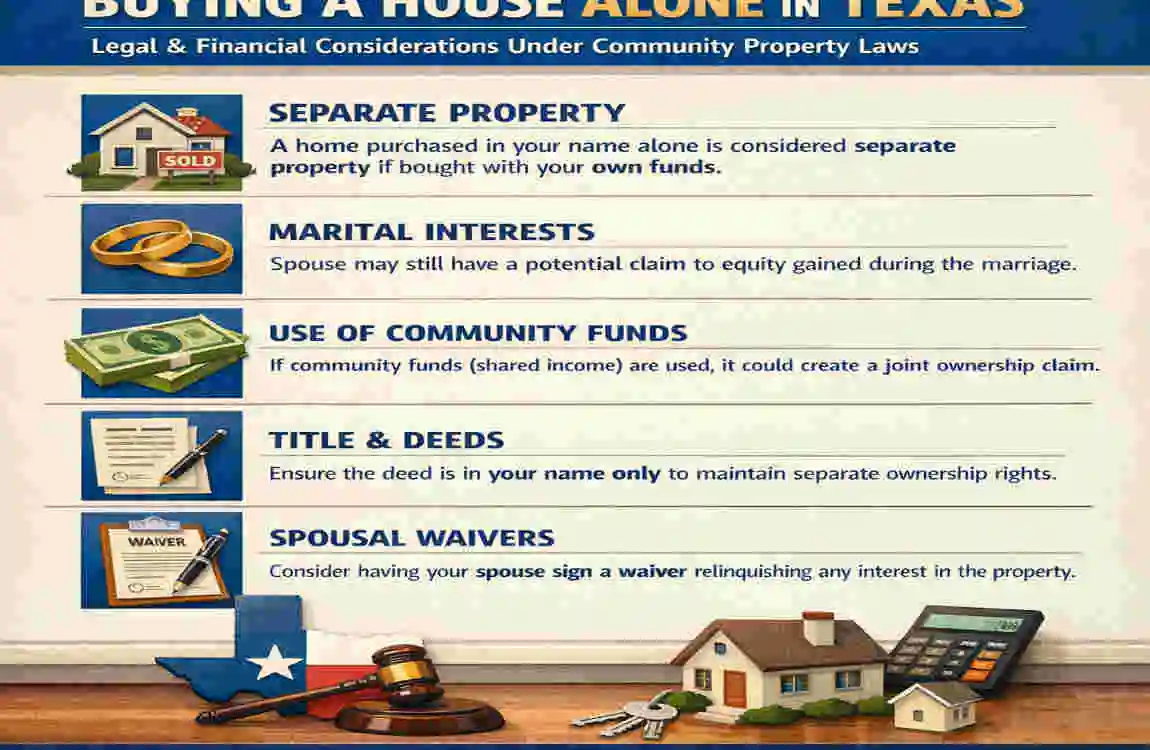
Separate Property Explained
Separate property is different. It generally includes:
- Property owned before marriage
- Gifts made to one spouse only
- Inheritances left to one spouse only
If one spouse uses separate property funds to buy a house, that home may qualify as separate property too. But this is only true if the spouse can clearly prove where the money came from.
That proof is important. Texas courts often look for strong documentation, such as bank records, closing statements, inheritance records, or other papers showing the money was separate all along.
Without that paper trail, the law may assume the property is community property.
Why Property Classification Matters
Property classification matters because it affects:
- Who owns the house
- Whether both spouses must sign
- How the home is divided in a divorce
- What happens if one spouse dies
- Whether the home can be used as collateral
If the home is community property, both spouses may have a legal interest even if only one name appears on the deed. If the home is separate property, the buying spouse may have more control, but only if the separate property claim is properly supported.
Here is a simple comparison:
Issue: Community Property, Separate Property
When acquired , usually during marriage , before marriage, or by gift/inheritance
Ownership is shared under Texas law. Belongs to one spouse
Source of funds : Usually marital earnings or shared funds , personal funds that can be traced
Consent concerns are often higher , but may be lower, depending on the homestead and lender rules
Divorce treatment is usually divided , and it usually stays with the original owner
This table gives a broad overview, but the facts of each case still matter a great deal.
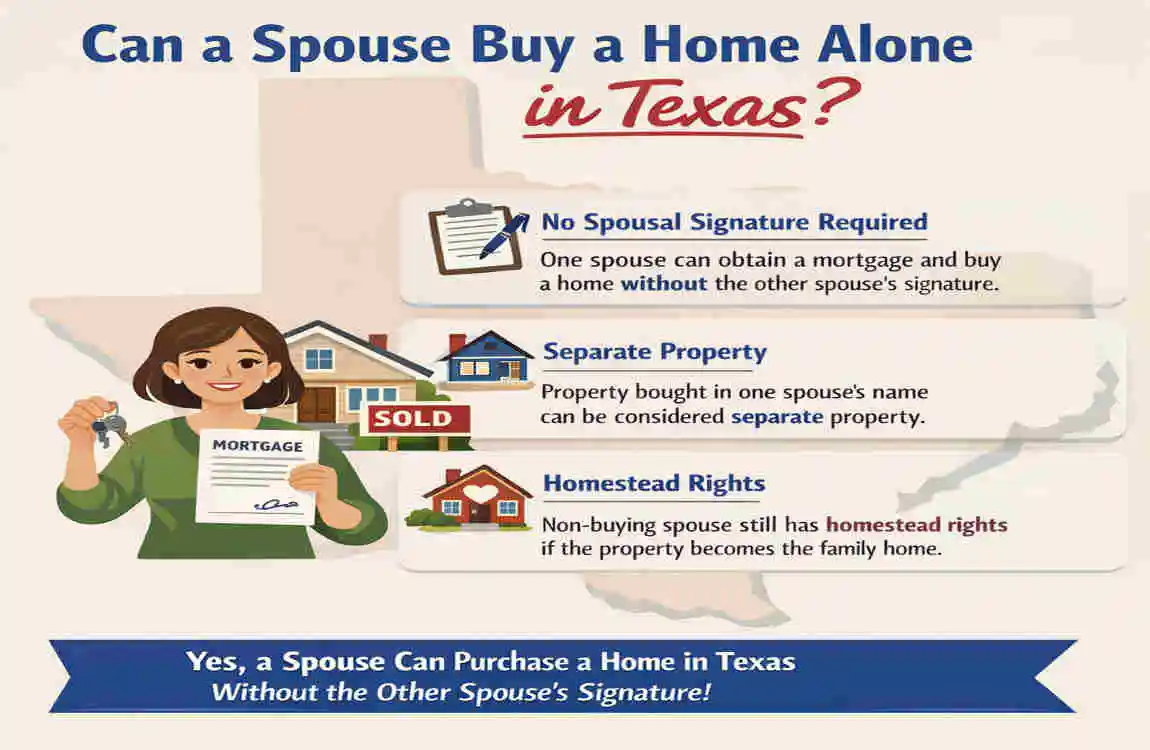
Can a Spouse Buy a House Without the Other in Texas?
This is the big question, and the answer is yes, but not always in the way people expect.
A married person in Texas may be able to buy a house alone if the purchase fits the right legal and financial rules. However, even when only one spouse signs the contract, the other spouse may still have rights if community funds are used or if the home becomes the family’s residence.
The Short Answer
The short answer is this: a spouse can sometimes buy a house without the other in Texas, but the purchase may still be affected by Texas marital property law, homestead law, and the lender’s rules.
So there are really three layers to think about:
- Legal ownership
- Lender approval
- Title and homestead protections
A spouse might be able to buy alone, but that does not always mean the house is fully separate or that the transaction is free from spousal rights.
Buying with Separate Property Funds
If one spouse uses separate property funds, buying alone is more likely to be allowed. For example:
- Money saved before the marriage
- An inheritance paid directly to one spouse
- Gift funds clearly given to one spouse
- Proceeds from selling the separate property
In these situations, the buying spouse may be able to purchase the home individually and keep it separate. But the money must be traceable.
That means you should be able to show:
- Where the funds came from
- That the funds were separate before the purchase
- That the funds were not mixed heavily with community money
If you mix separate and community funds, things can get messy fast. Once funds are blended, proving separate ownership becomes much harder.
Using Community Property Funds
If the home is purchased with community funds, the situation changes. Community funds are usually earnings or assets acquired during marriage. Since those funds are typically shared under Texas law, the spouse buying the home alone may not be the only person with a legal interest.
This is one of the main reasons a spouse can buy a house without the other in Texas, but it does not have a one-size-fits-all answer.
Even if only one spouse signs the contract, the other spouse may still be considered to have an interest in the property if community money paid for it. In practice, that can lead to:
- Ownership disputes
- Problems with the title
- Questions during divorce
- Issues when selling the home later
Lender Requirements and Credit Considerations
Even if the law allows a solo purchase, the lender may still require both spouses to be involved in some way.
Why? Because lenders care about risk. If a married borrower applies for a mortgage, the lender may look at:
- Credit score
- Debt-to-income ratio
- Income stability
- Existing debts
- State marital property rules
A lender may decide that the non-borrowing spouse’s debts still affect the household’s financial picture. In some cases, the lender may want both spouses to sign certain documents, even if only one spouse is on the loan.
That means there is a difference between:
- Who is legally allowed to buy
- Who must sign for the loan
- Who is listed on the title
- Who has rights under Texas law
These are not always the same person or the same set of people.
When Consent Is Required
In some Texas home purchases, spousal consent is not just a formality. It may be legally required. This often happens when the home is a homestead, or when the transaction affects rights that Texas law protects very strongly.
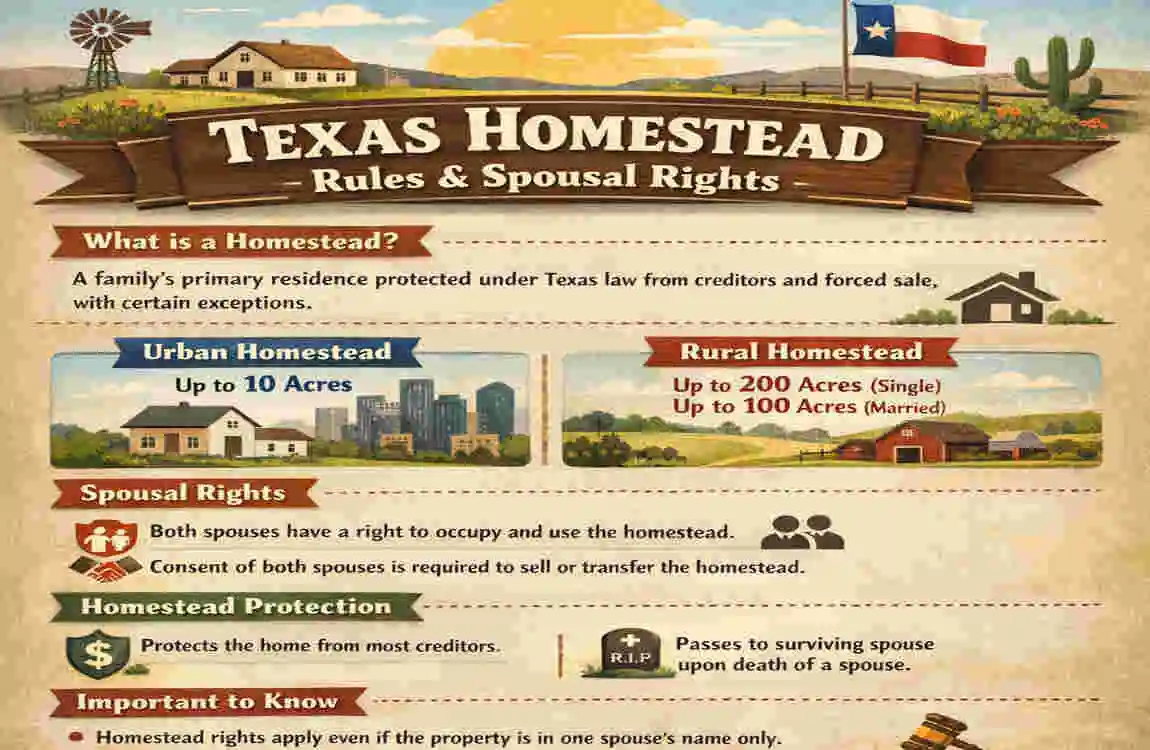
Homestead Laws in Texas
Texas has strong homestead protections, especially for a primary residence. If the house is going to be the family home, then both spouses may need to sign certain documents, even if only one spouse is on the loan or title.
A homestead is the main residence where a married couple or family lives. Texas law gives this property extra protection.
This matters because a homestead is not treated like a regular investment property. The law tries to prevent one spouse from making decisions that could harm the other spouse’s home rights without notice or consent.
In many cases, if the property is going to be the family homestead, both spouses must sign the deed of trust or mortgage documents. This helps ensure that the home cannot later be challenged because one spouse was left out.
Mortgage and Title Requirements
It is important to separate mortgage issues from title issues.
- Mortgage/loan: The debt you take on with a lender
- Title: The legal ownership record for the house
A spouse might be on the title but not on the mortgage. Or a spouse might be on the mortgage but not on the title. These are separate questions.
Lenders may require a spouse to sign loan-related documents for risk reasons. At the same time, title companies may require signatures based on marital property or homestead law.
So even if your name is the only one on the purchase contract, your spouse may still need to sign closing documents if the house is going to be a homestead or if the title company wants to clear any future disputes.
Legal Risks of Skipping Consent
Skipping consent can create real problems later.
Some of the most common risks include:
- The non-signing spouse later claims an ownership interest
- The title becomes difficult to sell or refinance
- A divorce court later treats the home as community property
- The mortgage or deed may be challenged
- The lender may refuse to fund the loan
In other words, trying to avoid your spouse’s involvement may save time at first, but it can create bigger issues later. A clean transaction is usually better than a rushed one.
Exceptions and Special Scenarios

There are some situations where one spouse buying alone makes more sense and may be more legally workable. These are often the exceptions that people ask about first.
Investment Properties
A spouse may buy an investment property alone more easily than a primary home. This is especially true if:
- The purchase uses separate funds
- The home will not be the marital homestead
- The buying spouse handles the mortgage individually
- The title is kept in one name or in a legal entity
Rental homes, vacation homes, and flipping properties often fall into this category. Still, if community funds are used, the other spouse may have an interest even if their name is nowhere on the deed.
Pre-Marital Purchases
If one spouse bought the house before marriage, it is often separate property. That means the original owner may keep more control over it.
But there is a catch. If the couple later uses the home as a homestead, or if mortgage payments are made with community funds after marriage, the property can become more complicated to classify. The separate property claim may still remain, but the spouse will need good records.
Separation or Divorce Situations
During separation or divorce, one spouse may want to buy a house alone while the marriage is still legally in place. This can happen, but it should be handled carefully.
At this stage, the legal status of the marriage still matters. Texas law does not stop applying just because spouses are living apart. Until the divorce is final, community property rules may still apply to income, debts, and purchases.
If you are in this situation, you should be especially careful about:
- The source of the down payment
- Whether the home will be a homestead
- Whether the purchase could be challenged later
- What the divorce court may say about the assets
Business Entities and Trusts
Some married buyers use an LLC or trust to purchase property. This is often done for investment or estate planning reasons.
This can help in some cases, but it does not automatically bypass Texas marital property law. If marital funds are used to fund the entity or purchase, the underlying property rights may still be complicated.
An LLC can make ownership cleaner on paper, but it does not erase the need to understand community property, homestead rules, and lender requirements.
Financial and Legal Risks to Consider
Buying a house is not only a legal decision. It is also a financial risk decision. If you try to buy solo without understanding Texas rules, you can end up with unexpected problems.
Here are the biggest risks.
Debt liability
If your name is on the mortgage, you are responsible for the debt. If the property is also tied to community funds, the marriage may still affect how that debt is treated.
Credit score effects
A solo mortgage can help or hurt your credit depending on your payment history. If payments are late, the damage can affect the borrowing spouse directly.
Ownership disputes
If the other spouse later argues that the house was bought with community funds, a court may treat it differently than you expected.
Tax implications
How a house is owned can affect tax planning, deductions, and future sale treatment. That is why it is smart to think ahead instead of only focusing on closing day.
Future divorce or estate issues
A house bought alone during marriage can become a major issue later if the marriage ends or if one spouse dies. The title, deed, and source of funds all matter when courts or heirs review the property.
The biggest lesson here is simple: the legal structure you choose now can shape your financial life for years.
Steps to Buy a House Solo in Texas
If you want to buy a home alone while married in Texas, do it in a careful and organized way. The more planning you do up front, the fewer surprises you are likely to face later.
Determine Property Classification
Start by figuring out whether the money you plan to use is separate property or community property.
Ask yourself:
- Did I earn this money before marriage?
- Is this money from a gift or inheritance to me alone?
- Are these funds mixed with marital funds?
- Can I document the source clearly?
If the answer is not clear, stop and get advice before moving forward. Property classification is the foundation of the entire purchase.
Get Pre-Approved for a Mortgage
If you plan to borrow money, get pre-approved in your own name.
This helps you learn:
- How much can you borrow
- Whether your income is enough on its own
- What debts the lender will consider
- Whether your spouse’s finances matter for the loan
A pre-approval can also show whether buying alone is realistic before you spend time house hunting.
Consult a Real Estate Attorney
This step can save you a lot of trouble.
A real estate attorney can help you understand:
- Whether the home can be bought as separate property
- Whether your spouse must sign the closing documents
- How the title should be handled
- What risks may exist under Texas law
You do not need to guess your way through this. A short legal review may prevent a long and expensive dispute later.
Work with a Real Estate Agent
A knowledgeable real estate agent can help you find homes that fit your goals and avoid delays during the transaction.
A good agent can help you:
- Understand what sellers expect
- Coordinate with the lender and title company
- Spot possible issues early
- Keep the transaction moving smoothly
While an agent is not a lawyer, they can still help make the process easier and more organized.
Finalize Purchase and Title Documentation
When you reach closing, make sure the paperwork matches your plan.
Check:
- Who is on the deed
- Who is on the loan
- Whether spousal signatures are required
- Whether the property will be a homestead
- Whether your separate property records are complete
A mistake at closing can create problems that are hard to fix later. It is much better to catch issues before signing.
Here is a simple checklist to keep in mind:
- Confirm the source of funds
- Review the title and loan documents
- Ask whether the homestead rules apply
- Get legal advice if anything is unclear
- Keep every record tied to the purchase
Tips for Married Couples Considering Solo Home Buying
If you and your spouse are thinking about one person buying a home alone, the best thing you can do is talk openly. Many problems begin when couples avoid the subject or assume they know how the law works.
A few smart habits can make a big difference:
- Be honest about your goals. Are you buying for investment, privacy, or convenience?
- Keep financial records clear. Save bank statements, deposit records, and closing documents.
- Discuss long-term plans. Think about divorce, inheritance, refinancing, and future resale.
- Do not guess about the law. Texas property rules are detailed, and small facts can change the outcome.
- Stay aligned on expectations. Even if only one spouse is buying, both spouses should understand the risks and benefits.
When couples communicate early, they usually avoid misunderstandings later. That is especially true with real estate, where one decision can affect both people for years.
Common Mistakes to Avoid

Many buyers make the same mistakes when they assume a solo purchase will be simple. In Texas, those mistakes can be costly.
One of the biggest mistakes is ignoring community property rules. People often think a single signature means single ownership. That is not always true.
Another mistake is not consulting legal professionals. A real estate attorney can explain things that a lender or agent may not fully cover.
A third mistake is assuming that lender rules and legal rules are the same. They are not. The lender cares about loan risk. The law cares about ownership and rights.
Finally, many buyers fail to document separate funds. Without clear records, a separate property claim can be hard to prove.
If you avoid these mistakes, you put yourself in a much stronger position.
FAQs
Q: Can a spouse buy a house without the other in Texas?
Yes, sometimes. A spouse may be able to buy a house alone in Texas, especially if the purchase uses separate property funds and the home is not a homestead. But community property rules, title issues, and lender requirements may still affect the deal.
Q: Do both spouses have to be on the mortgage in Texas?
Not always. The lender decides who must sign the loan based on income, credit, debt, and risk. But even if only one spouse is on the mortgage, the other spouse may still need to sign some documents if the home is a homestead or if Texas law requires it.
Q: What is a homestead law in Texas?
A homestead law protects a family’s primary home. In Texas, homestead rules can limit how a home is handled and often require both spouses to sign certain documents. This helps protect the non-borrowing spouse’s rights in the residence.
Q: Can I buy a house with my own money while married?
Yes, if the money is truly separate property and you can prove it. That usually means the money came from before the marriage, a gift, or an inheritance, and it was not mixed heavily with community funds.
Q: What happens if only one spouse is on the title?
If only one spouse is on the title, that does not always mean the other spouse has no rights. Texas community property law, homestead protections, and the source of the purchase funds can all affect ownership. The title alone does not always tell the full story.