What Pressure Should My House Water Be at for Optimal Plumbing? Expert Guide
Home Improvement Plumbing

What Pressure Should My House Water Be at for Optimal Plumbing? Expert Guide

You step into the shower after a long, exhausting day, expecting a powerful stream of hot water to wash away the stress. Instead, you are greeted by a sad, pathetic trickle that barely rinses the shampoo out of your hair. Or perhaps the opposite happens—you turn off the kitchen faucet and hear a loud BANG that echoes through your walls like a gunshot.

If you are guessing, you are gambling with your pipes. Water pressure is the lifeblood of your home’s plumbing system. Too low, and your daily tasks become frustrating chores. Too high, and you are looking at potential pipe bursts, leaking appliances, and a shortened lifespan for your water heater.

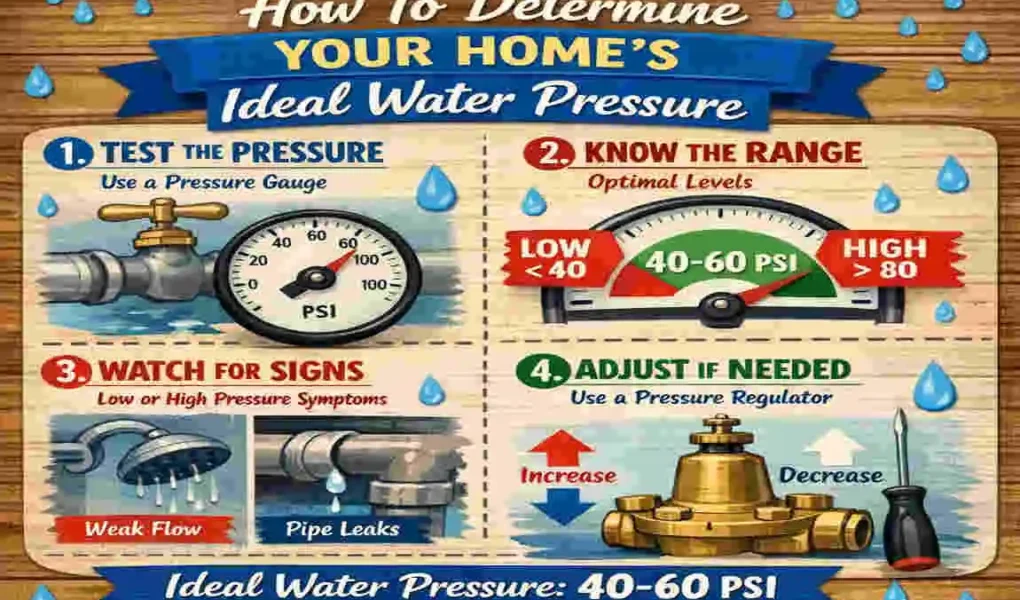
The sweet spot? For most homes, the magic number lies between 40 and 60 PSI. Staying within this range ensures you get a satisfying shower flow without putting your pipes under the kind of stress that can lead to catastrophic leaks. In fact, studies suggest that homes with improper water pressure face up to 20% higher repair costs over the lifespan of their plumbing.

Understanding Water Pressure Basics

What Pressure Should My House Water Be at for Optimal Plumbing? Expert Guide

Before we dive into the numbers, we need to understand exactly what we are dealing with. What is water pressure, really?

In the simplest terms, water pressure is the force that pushes water through your pipes and out of your fixtures. Think of it like blood pressure in the human body. Just as your blood needs a certain amount of pressure to circulate through your veins to reach your extremities, your water needs force to travel from the main line, up through your walls, and out of your second-story showerhead.

If your blood pressure is too low, you feel faint; if it’s too high, you risk heart damage. Your plumbing works the same way.

The Key Factors Affecting Your Pressure

You might wonder why your neighbor has fire-hose pressure while you are struggling to fill a pot of water. Several variables come into play:

  1. Municipal Supply: This is the big one. City water mains often pump water at incredibly high pressures—sometimes 100 to 200 PSI—to ensure it can travel far distances and reach fire hydrants. By the time it reaches your house, it’s usually been tampered with.
  2. Elevation: Gravity is a law you cannot break. If your home is at the bottom of a hill, gravity adds weight to the water, naturally increasing pressure. Conversely, if you live at the top of a steep hill, the municipal pumps have to fight gravity to get water to you, resulting in lower natural pressure.
  3. Pipe Size and Condition: Pipe diameter matters. A wider pipe can deliver more volume, but if your pipes are clogged with rust or mineral deposits (common in older galvanized steel pipes), the effective pressure drops significantly as the water struggles to squeeze through.

Why It Matters for Your Plumbing Health

Maintaining that 40-60 PSI range isn’t just about comfort; it’s about balance.

  • Performance: You need enough force to run multiple fixtures. For example, a standard showerhead requires about 2.5 Gallons Per Minute (GPM) flow rate to feel “good.”
  • Longevity: Appliances like washing machines and dishwashers have inlet valves designed for specific pressure ranges. Exceeding them is a fast track to blowing a seal and flooding your laundry room.

PSI Thresholds at a Glance

To help you visualize where you stand, here is a breakdown of the zones:

  • 40-60 PSI (The Goldilocks Zone): Ideal for multi-fixture use. You can flush the toilet while someone is showering without scalding them.
  • Below 30 PSI (The Danger Zone – Low): This is considered a trickle. It’s annoying, but it can also be a code violation in some areas because it can prevent fire suppression systems from working.
  • Above 80 PSI (The Danger Zone – High): This is the “Red Zone.” At this level, water is acting like a jackhammer inside your pipes. It voids warranties on many appliances and drastically increases the risk of bursts.

Ideal PSI Range for Your Home

So, let’s answer the specific query: what pressure should my house water be at, according to plumbing standards?

For the vast majority of residential homes in the U.S. and many other regions, such as Pakistan (specifically Lahore), the target is 45-55 PSI. Most professional plumbers will set a Pressure Reducing Valve (PRV) to 50 PSI as the default.

Why this specific number? It provides enough “oomph” to get water to the third-floor bathroom without blowing the gaskets off your kitchen faucet.

Detailed Pressure Status Table

Below is a detailed breakdown of what each pressure level means for your home.

PSI Level Status Effects on Plumbing Recommendations

40-60 PSI Optimal Strong, consistent flow; minimal wear and tear on joints and seals. Maintain. Check annually to ensure it stays here.

30-40 PSI Low Slow tub fills; weak showers; washing machines take longer to cycle. Monitor. Consider a booster pump if it drops further.

60-80 PSI Acceptable. You might notice some noise, slight stress on appliances. Caution. If it creeps toward 80, install a PRV.

80+ PSI : Too High . Water hammer; leaking faucets; ruptured hoses; shortened water heater life. Urgent Action. You need a pressure regulator immediately.

Important Variations to Consider

The Age of Your Home Matters. If you live in a historic home with original plumbing, you need to be careful. Older homes often have galvanized steel pipes or older copper connections that have weakened over decades. For these homes, sticking to the lower end of the spectrum (around 40-45 PSI) is safer. High pressure in an old pipe is a recipe for a pinhole leak.

New Builds and PEX Modern homes built with PEX (cross-linked polyethylene) piping are generally more robust. They can better handle fluctuations than older copper systems, but even PEX has its limits. The fittings and connections are usually the weak points, not the pipe itself.

Regional Fluctuations. In areas with inconsistent municipal power or water supply, such as parts of Lahore or rural U.S. regions, pressure can fluctuate wildly. In these cases, aiming for a baseline of 50 PSI gives you a buffer. If the city pressure drops slightly, you still have flow; if it spikes, you aren’t immediately in the danger zone.

How to Test House Water Pressure

What Pressure Should My House Water Be at for Optimal Plumbing? Expert Guide

You cannot fix what you don’t measure. The good news is that testing your water pressure is one of the easiest and cheapest DIY plumbing tasks you can do. You do not need to call a professional for this initial check.

Step-by-Step Guide to Testing

What you need: A simple water pressure gauge. You can find these at any hardware store (like Home Depot, Lowe’s, or Amazon) for $10 to $20. Look for one with a “lazy hand” or a red marker that stays at the highest recorded pressure—this helps catch spikes.

The Process:

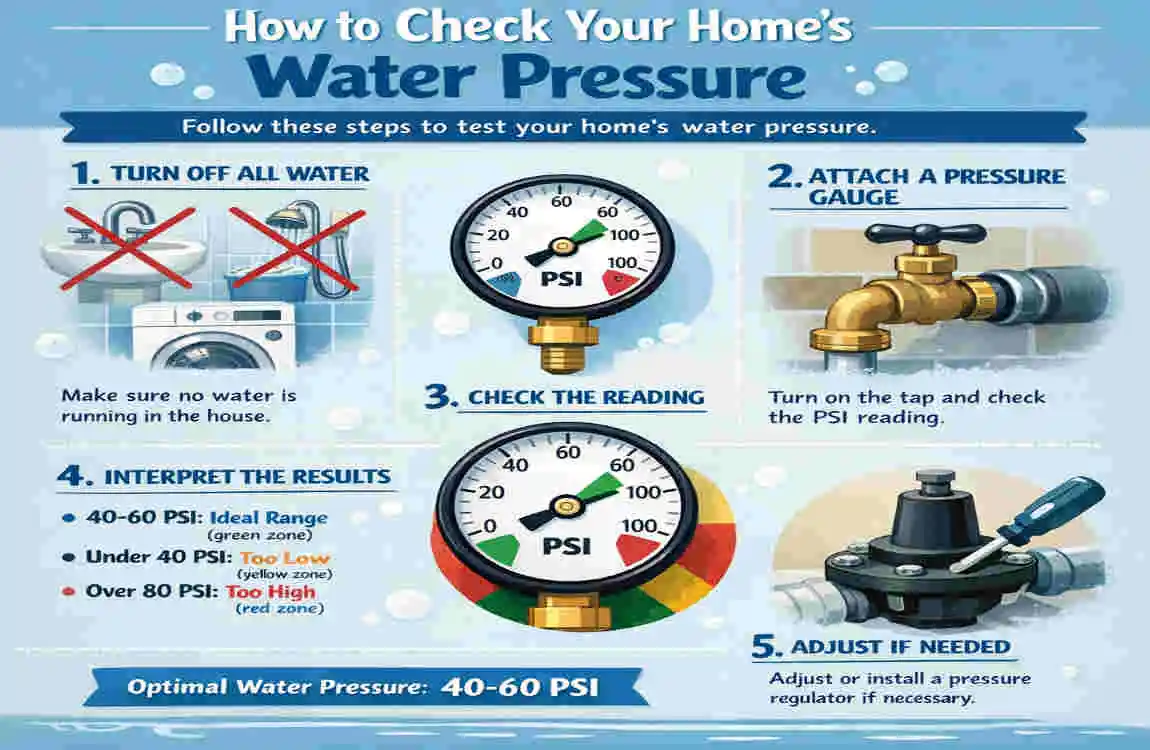
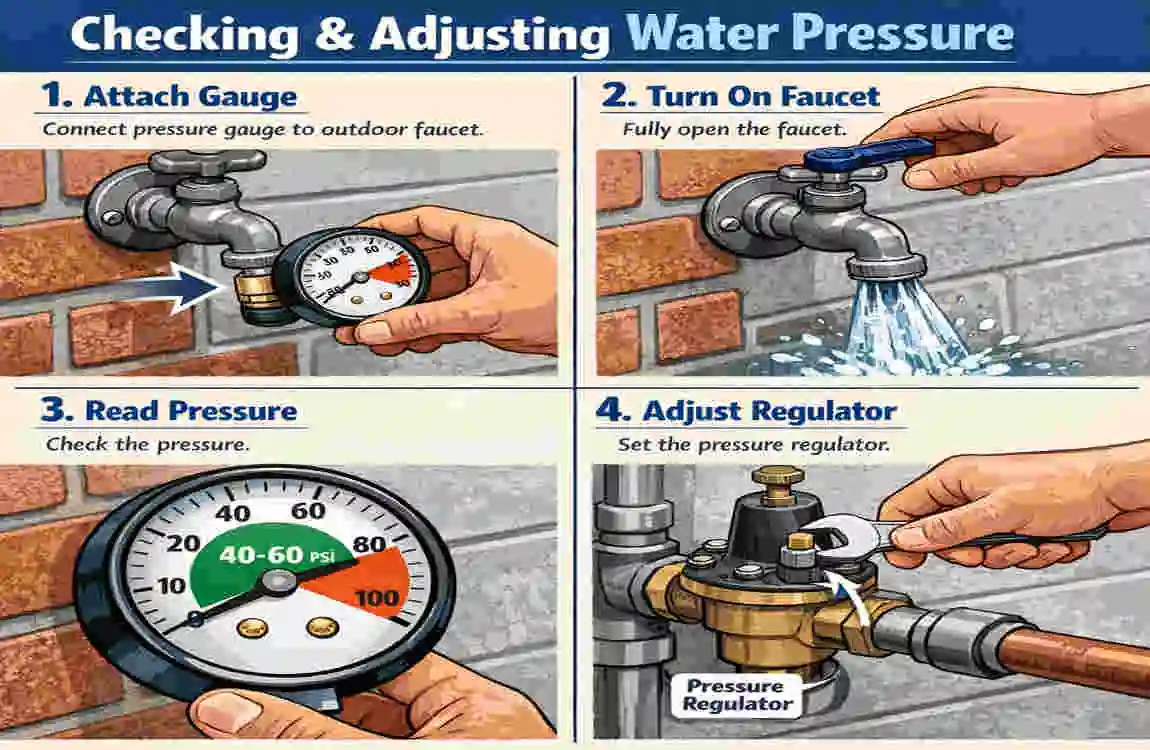
  1. Turn Off the Water Inside: Go through your house and make sure everything is off. No washing machines running, no dishwashers, no sprinklers, and no ice makers filling up. You want a “static” reading.
  2. Locate the Test Point: The best place to test is an outdoor hose bibb (spigot) or the drain valve on your water heater. Ideally, choose the faucet closest to where the main water line enters your house. This gives you the most accurate reading of what the city is delivering.
  3. Attach the Gauge: Screw the pressure gauge onto the faucet threads. Make sure it is tight to prevent leaks, as they can give you a false low reading. You might need a pair of pliers to get it snug, but hand-tight is usually sufficient.
  4. Open the Valve: Turn the faucet all the way on. The needle on the gauge will jump.
  5. Read the Static Pressure: Look at the number. This is your static pressure. Write it down.
  6. Test Dynamic Pressure (Optional but Recommended): Leave the gauge on. Go inside and flush a toilet or run a sink. Watch the gauge outside. If it drops significantly (more than 5-10 PSI), you might have a volume/restriction problem, not just a pressure problem.

Troubleshooting Your Readings

  • Morning vs. Night: Water pressure isn’t constant. It often peaks late at night when fewer people in the neighborhood are using water. If you test at 5:00 PM, you might see 50 PSI, but at 2:00 AM, it might spike to 90 PSI. This is why a gauge with a “lazy hand” (peak indicator) is great—leave it on overnight.
  • Inconsistent Readings: If you get 40 PSI at the hose bib but the shower upstairs feels like 20 PSI, you likely have a restriction (clog) inside the house pipes, not a pressure issue from the street.
  • Digital vs. Analog: Analog gauges are fine for general checks. Digital gauges offer more precision but are generally unnecessary for a basic home check.

Safety Note: If you decide to test from the water heater drain valve, be careful—the water can be hot!

Signs and Risks of Incorrect Pressure

Your house will usually tell you if the pressure is wrong. You need to know how to listen.

Low Pressure Issues (Under 40 PSI)

Low pressure is rarely dangerous to plumbing, but it is incredibly frustrating for homeowners.

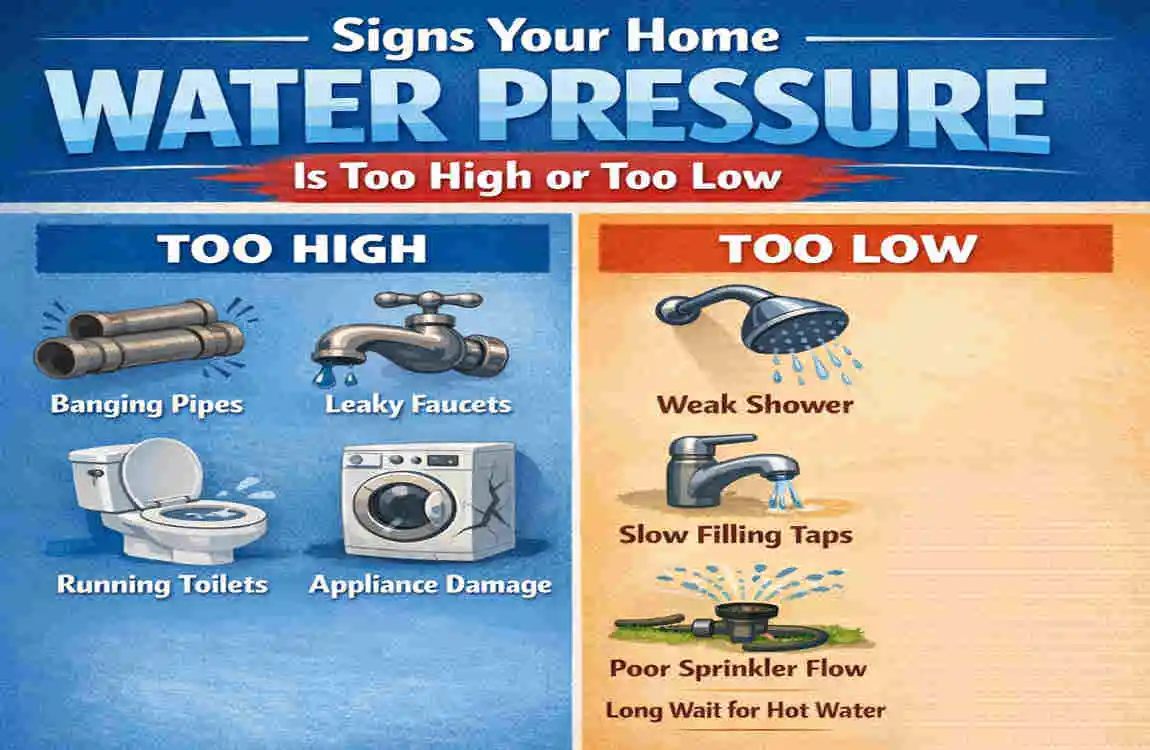
  • The “Shower Dance”: You find yourself running around the shower trying to get wet because the spray is so weak.
  • Appliance Timeout: Your washing machine takes twice as long to fill, or it errors out because it thinks the water supply is cut off.
  • No Multi-Tasking: If someone flushes the toilet, the sink water practically stops.

Common Causes:

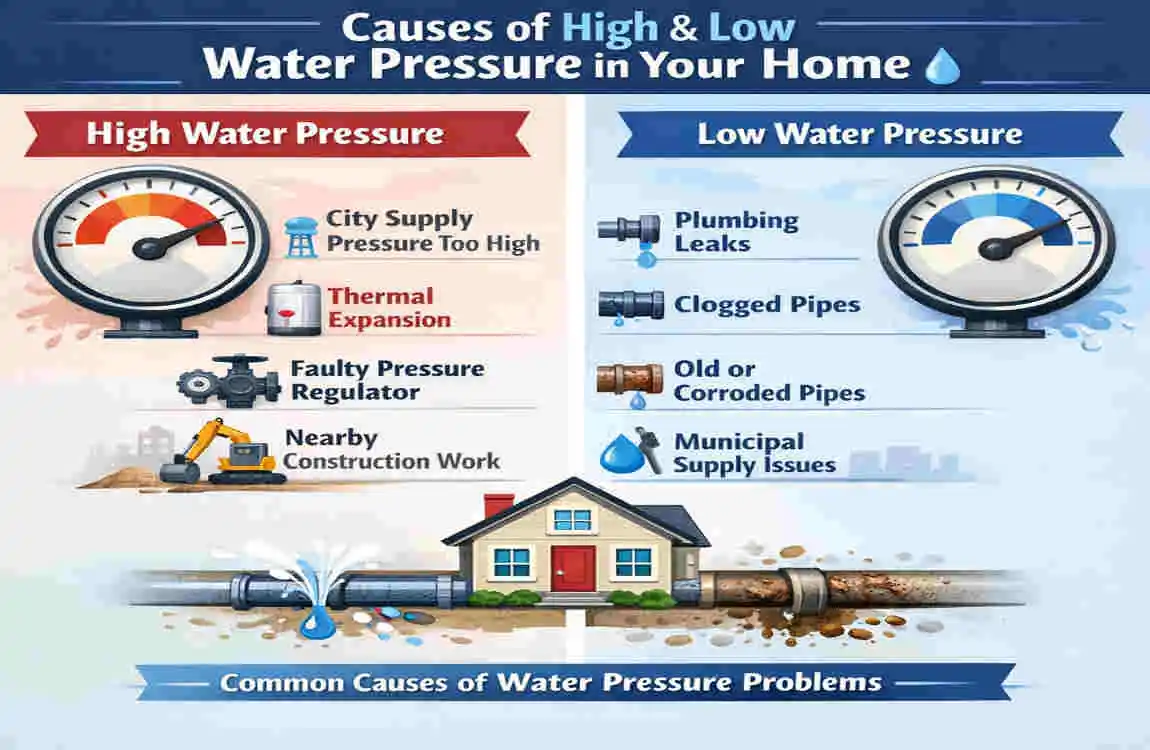
  • Hidden Leaks: A major underground leak can divert water, lowering pressure.
  • Clogged Aerators: Sometimes it’s not the whole house; it’s just mineral buildup on the faucet tip.
  • Corrosion: In older steel pipes, rust builds up on the inside, narrowing the pipe diameter like a clogged artery.

High Pressure Problems (Over 80 PSI)

High pressure is the silent killer of home plumbing. It creates stress that accumulates over time until something breaks.

  • Water Hammer: This is the most obvious sign. When a valve closes (like a toilet filling up or a washing machine cycle changing), the water stops abruptly. If the pressure is high, that momentum slams against the pipe, creating a loud BANG or shudder. This shockwave can crack fittings.
  • Leaking Faucets: High pressure forces water past the rubber washers and ceramic discs in your faucets, causing persistent dripping.
  • Shortened Appliance Life: Your water heater, dishwasher, and ice maker are rated for specific pressures. ConsistentConsistent 90+ PSI can reduce a water heater’s lifespan by years and lead to catastrophic tank ruptures.
  • Wasted Water: At high pressure, you are using significantly more water than you need for every minute a tap is open, driving up your utility bills.

Fixes for Low Water Pressure

What Pressure Should My House Water Be at for Optimal Plumbing? Expert Guide

If your gauge reads below 40 PSI, do not panic. Start small before spending big money.

DIY Solutions (Try These First)

  • Clean Your Aerators: Unscrew the little mesh cap at the end of your faucets. Soak them in vinegar to dissolve calcium and lime buildup. This fixes “low pressure” on individual sinks 50% of the time.
  • Check the Main Shut-off Valve: It sounds silly, but sometimes the main valve isn’t fully open. If it’s a wheel handle, turn it counter-clockwise until it stops. If it’s a lever, ensure it is parallel to the pipe.
  • Pipe Insulation: In cold climates, partial freezing can reduce flow. Ensure exposed pipes are insulated.

The Pressure Booster Pump

If your municipal supply is naturally low (common in uphill areas) or you are on a weak well system, you may need a water pressure booster pump.

  • This device installs on your main line and uses an electric pump to repressurize the water coming into your home.
  • Cost: A decent unit runs $200 to $500, plus installation.

Repiping

If your home has old galvanized pipes that are rusted shut, no pump will help. You need to replace the pipes with Copper or PEX. This is a major renovation project.

Cost Comparison Table:

Fix Estimated Cost Difficulty Level

Clean Aerators $0 (Free) DIY (Easy)

Replace Main Valve $150 – $400 Pro Recommended

Pressure Booster Pump $300 – $1,000+ Pro Required

Repiping House $5,000 – $15,000 Pro Required

Solutions for High Water Pressure

If you are in the 80+ PSI danger zone, you need to act fast to protect your investment.

The Primary Fix: The Pressure Reducing Valve (PRV)

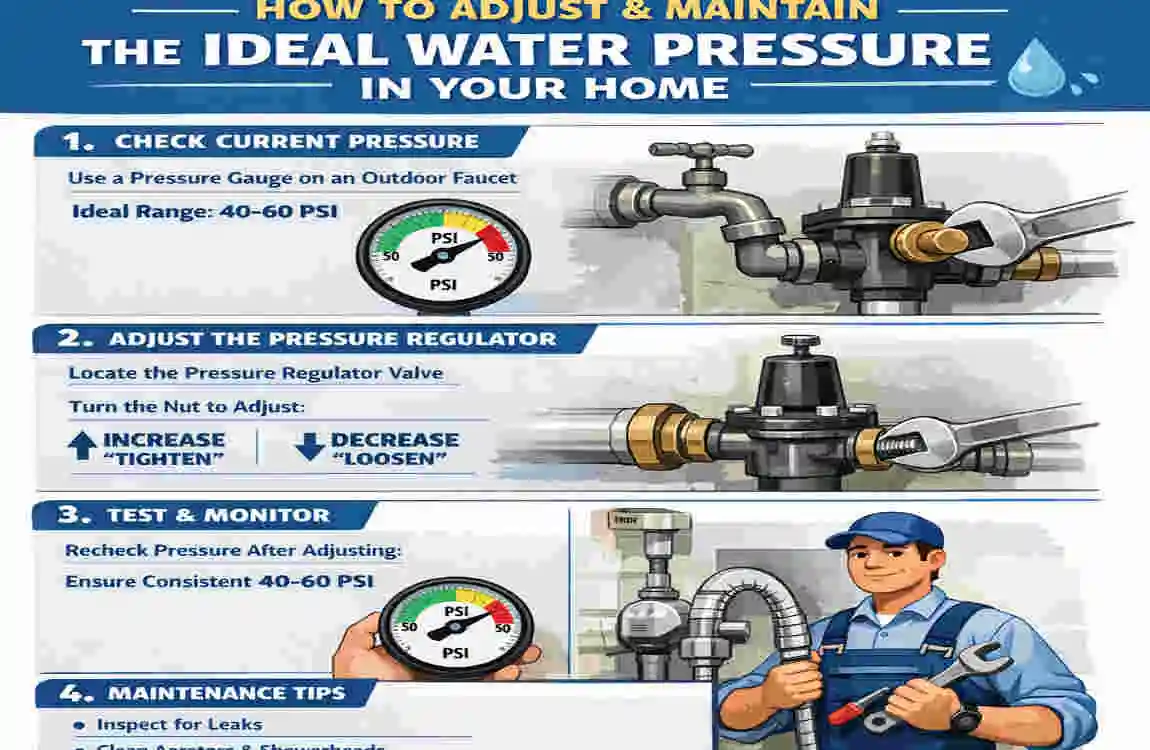
The PRV is your plumbing’s best friend. It is a bell-shaped brass valve usually located on the main water line next to the shut-off valve. It takes the high pressure from the city (say, 100 PSI) and reduces it to a safe, steady flow (50 PSI) for your house.

  • Adjustment: If you already have one, it needs adjusting. There is a bolt on top. Loosening it generally lowers the pressure, while tightening it raises it (check the manufacturer’s tag).
  • Replacement: PRVs wear out after 10-15 years. If yours is old, it might have failed open, letting high pressure pass through.

Thermal Expansion Tank

If you have a closed plumbing system (which you do if you have a PRV), water expands when it’s heatedby . Since it can’t flow back to the city main, it increases pressure inside your house (thermal expansion). A small expansion tank absorbs this extra volume.

  • If your pressure spikes only when the water heater is running, you need an expansion tank.

Whole-House Regulator

For extreme cases, a heavy-duty regulator is installed.

  • Cost: Expect to pay between $300 and $800 for a professional installation of a new PRV and expansion tank.

Long-Term Plumbing Maintenance Tips

What Pressure Should My House Water Be at for Optimal Plumbing? Expert Guide

Maintaining the correct pressure is an ongoing process, not a one-time fix. Here is how to keep your system healthy for decades.

Quarterly Gauge Checks

Make it a habit. When you change your HVAC filters or check your smoke detectors, screw that $10 gauge onto the hose bibb and check the PSI. Catching a PRV failure early can save you thousands in flood damage.

Combat Hard Water

If you live in an area with hard water (high mineral content), scale will build up in your pipes and valves, reducing flow and damaging your PRV.

  • Solution: install a water softener. It protects the inside of your pipes just as much as it helps your skin and laundry.

Smart Water Monitors

Technology has come a long way. Devices like the Flo by Moen or Phyn attach to your main line. They monitor pressure, flow rate, and temperature 24/7.

  • If they detect a tiny leak or a pressure spike, they send an alert to your phone.
  • If a pipe bursts, they can automatically shut off the water to the house, preventing a catastrophe.

Professional Tips for Homeowners:

  1. Flush your water heater annually to remove sediment that can cause pressure fluctuations.
  2. Monitor your water bill. A sudden jump in usage without a change in habits is a sure sign of a hidden leak affecting pressure.
  3. Winterize outdoor faucets. Frozen pipes expand and burst, which ruins system pressure.
  4. Know your main shut-off. In an emergency, you need to cut the water in seconds, not minutes.
  5. Schedule an annual inspection. Have a pro plumber look at your PRV and main connections once a year.

FAQs

Here are the most common questions homeowners ask about “what pressure should my house water be at plumbing.”

Q: What pressure should my house water be at plumbing-wise? A: The ideal range is 40 to 60 PSI. Most plumbers aim for a steady 50 PSI to balance performance and safety.

Q: Is 70 PSI too high for a house? A: It is on the high side, but generally acceptable for modern plumbing (Copper/PEX). However, it puts unnecessary stress on appliances. If it creeps higher, install a regulator.

Q: How often should I test my water pressure? A: Ideally, every 6 months. At a minimum, check it once a year or whenever you notice a change in flow or hear banging pipes.

Q: Does city water have higher pressure than well water? A: Typically, yes. City mains rely on massive pumps and gravity, often delivering 100+ PSI. Well systems rely on your personal pump and pressure tank, which usually cycle between 40 and 60 PSI naturally.

Q: How long does a Pressure Reducing Valve (PRV) last? A: A PRV usually lasts 5 to 10 years, depending on water quality. If you have hard water, it may fail sooner.

You may also like...

Leave a Reply

Your email address will not be published. Required fields are marked *