Have you ever found yourself doom-scrolling through news about tech layoffs, AI taking over jobs, and the general uncertainty of the global economy? You aren’t alone. It’s a stressful time to be mapping out a career path. Whether you are a fresh high school graduate trying to decide on a major or someone mid-career feeling stuck in a cubicle, the question of stability is probably keeping you up at night.
The short answer is a resounding yes. In fact, it might be one of the smartest financial and strategic moves you can make in 2026. Plumbing offers high demand, a recession-proof nature, and surprisingly strong earning potential that often outpaces white-collar roles—without the crippling student loan debt.
According to the U.S. Bureau of Labor Statistics (BLS), the industry is projected to grow at a steady 2% through 2032. That might sound modest, but when you dig into the numbers, that translates to about 43,300 job openings every single year ([Link to BLS]). This isn’t just about unclogging toilets; it’s about critical infrastructure, green technology, and securing your financial future.
Why Plumbing Stands Out in Today’s Job Market
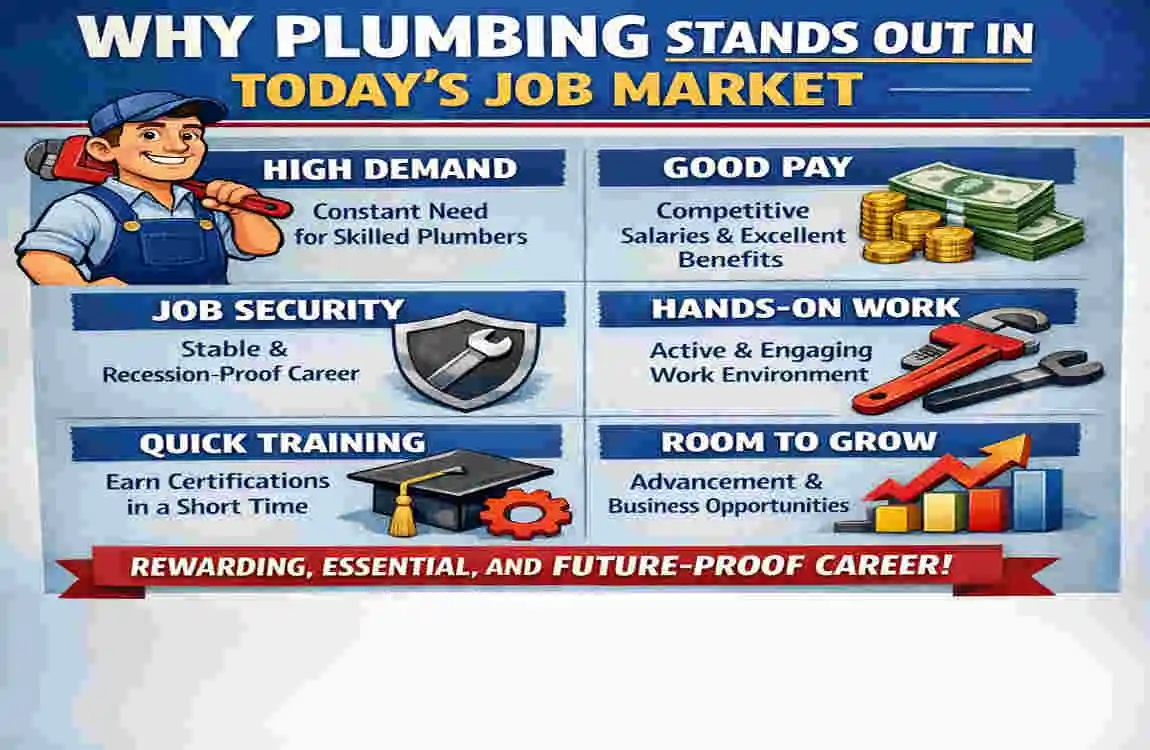
When we talk about career security, we have to look at supply and demand. Right now, the scales are tipped heavily in favor of skilled tradespeople. While other industries fluctuate based on stock market trends or the latest app craze, the need for plumbing is biologically and structurally constant.
Recession-Resistant Demand
Think about it: when the economy takes a nosedive, people might stop buying new cars. They might cancel their Netflix subscriptions or skip the annual vacation. But what happens if a pipe bursts in the basement? What happens if the water heater dies in the middle of winter?
They call a plumber. They have to.
This makes plumbing an incredibly recession-resistant career. It is an essential service. According to data from HomeAdvisor and similar platforms, there are over 120 million households in the United States alone. Every single one of them features complex piping systems that degrade over time. As long as people use running water and indoor heating, there will be a robust demand for your skills. You aren’t selling a luxury; you are selling a necessity.
The “Graying” of the Workforce
There is a massive opportunity right now caused by a demographic shift often called the “Silver Tsunami.” The current workforce of skilled tradespeople is aging out.
Recent statistics suggest that nearly 40% of plumbers are over 55 and inching toward retirement. For every few tradespeople leaving the workforce, there are not enough young apprentices entering to replace them. This creates a massive labor shortage.
What does this mean for you?
- Higher Wages: AA supply shortage shortage leads to higher costs. Companies are paying premium rates to attract talent.
- Job Security: You won’t be fighting 500 other applicants for one position.
- Fast Tracking: With fewer senior plumbers available, motivated newcomers can move up the ranks to management or ownership more quickly than in other industries.
A Bright Plumbing Job Outlook
The industry isn’t just stable; it is evolving. We aren’t just talking about fixing leaks anymore. A massive push toward green technology is boosting the outlook for plumbing jobs.
As governments and homeowners push for water conservation and energy efficiency, plumbers install the tech. From tankless water heaters to gray-water recycling systems, the scope of work is expanding faster than average. If you position yourself as an eco-friendly plumbing expert, you are essentially future-proofing your career for the next thirty years.
Earning Potential: Plumber Salary Expectations
Let’s talk about money. There is a tired stigma that tradespeople don’t earn as much as university graduates. This is not only false; it is becoming laughably inaccurate. When you factor in the lack of student debt and the ability to earn overtime, plumbers often come out ahead.
Entry-Level Pay
When you start as an apprentice, you are essentially a student. But unlike a university student paying for classes, you are paid to learn.
- Apprentice Wages: Generally start between $18 and $25 per hour.
- Annual Entry-Level: You can expect to gross between $45,000 and $55,000 in your first few years of training.
Compare this to an entry-level marketing or admin role that requires a degree, and you’ll see the math starts to look very good, very quickly.
Mid-Career and Master Plumber Earnings
Once you get your license and move from apprentice to journeyman, your income jumps significantly.
- Journeyman/Mid-Career: Salaries typically range from $60,000 to $90,000.
- Top Earners: The top 10% of plumbers, usually Master Plumbers or those with niche specializations, easily clear $100,000+ annually. The BLS listed the median pay at roughly $61,550 as of 2025, but this median often skews lower because it includes apprentices. Experienced professionals earn much more.
Factors That Boost Your Income
Not all plumbing jobs pay the same. If you want to maximize your plumber’s salary expectations, keep these factors in mind:
- Specialization: Commercial plumbers (working on skyscrapers, hospitals) usually make more than residential service plumbers.
- Overtime/Emergency Calls: If you are willing to work nights or weekends, you can earn double-time. That “emergency rate” adds up fast.
- Entrepreneurship: This is the big one. Many plumbers eventually start their own businesses. Once you are the owner, the ceiling on your income essentially disappears—owners of plumbing firms frequently net $150,000 to $250,000+.
Global Salary Comparison
To give you a broader perspective on how this career pays around the world, here is a quick breakdown. Note that the cost of living varies wildly between these locations.
Location Avg. Annual Salary (Est.)Notes
Lahore, PK PKR 800K – 1.5M Skilled independent contractors can earn significantly more with a solid client base.
USA Avg. $61,550 Varies heavily by state (e.g., NY and CA pay higher).
UK £40,000 – £60,000. London rates are much higher than the rest of the UK.
Canada CAD $70,000 – $90,000. High demand in urban centers like Toronto and Vancouver.
Path to Success: How to Become a Plumber
One of the most attractive parts of this career is the low barrier to entry. You don’t need a 4.0 GPA, you don’t need to write admission essays, and you don’t need four years of unpaid study.
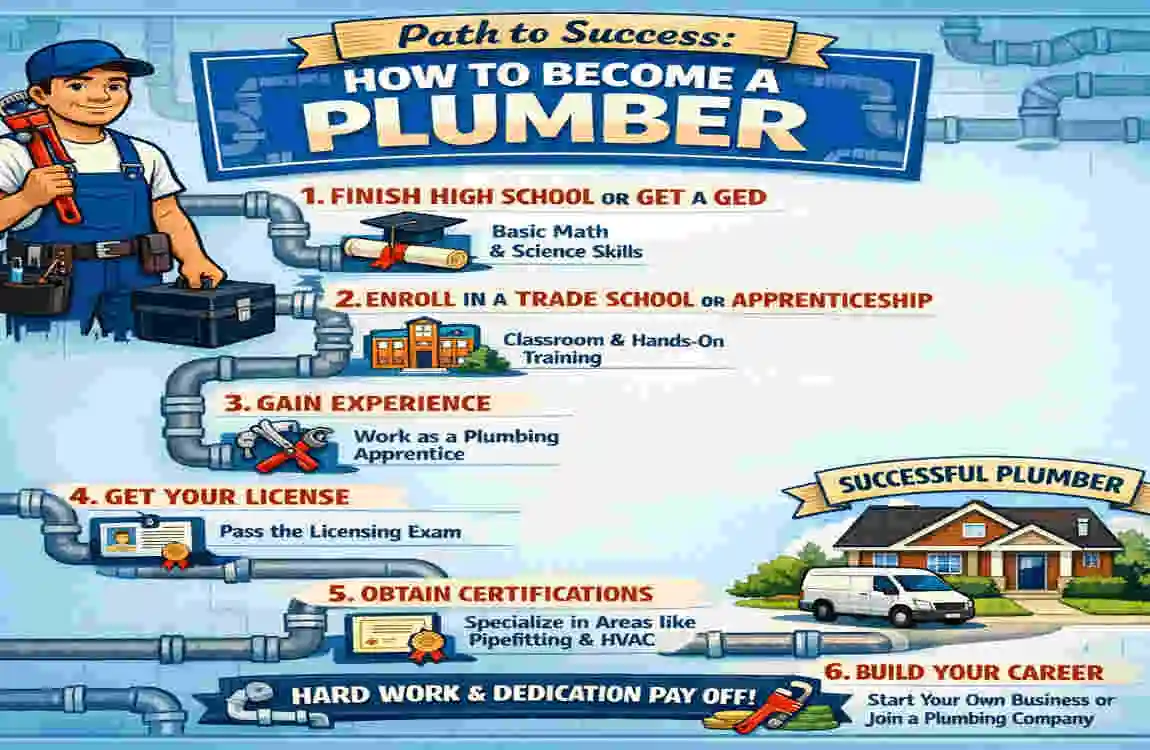
Here is a step-by-step breakdown of how to become a plumber.
Education Basics
The foundation is simple: you need a High School Diploma or a GED. You need a basic grasp of math (algebra and geometry help for measuring pipes and volumes) and decent reading comprehension for codebooks.
- Optional Step: Some people attend a vocational school for a pre-apprenticeship program (6 months to 1 year). This teaches you safety and tool identification, making you a more attractive hire, but it is not strictly mandatory.
The Apprenticeship (The Gold Standard)
This is the core of the trade. You don’t learn plumbing from a book; you learn it with a wrench in your hand.
- Duration: Typically 4 to 5 years.
- The Structure: You work under a Master Plumber for 2,000 hours a year (paid work) and attend classroom instruction for about 200 hours a year.
- The Benefit: You are earning a living wage from Day 1. By the time you finish, you have 5 years of salary in the bank and zero debt.
Licensing and Exams
Plumbing protects the nation’s health (bad plumbing causes disease), so it is a regulated industry.
- After your apprenticeship, you must pass a state or provincial licensure exam.
- This written and practical test proves you know the building codes and safety protocols.
- Once passed, you become a Journeyman Plumber.
Master Status
After working as a Journeyman for a few years (usually 2-5, depending on the region), you can take the Master Plumber exam. This allows you to pull permits, design systems, and own your own business.
Costs and Timeline
The estimated total cost for books and tools ranges from $5,000 to $15,000 over four years—a fraction of the cost of a university degree. You are usually fully employable within a week of getting accepted into an apprenticeship.
Success Story: Consider “Mike,” who skipped college at 18. He joined a local union apprenticeship. By 22, he was a licensed journeyman making $75k. By 25, he started his own LLC. Today, at 30, he has three vans on the road and a six-figure income, while his high-school friends are just finishing paying off their student loans.
The Honest Truth: Pros and Cons of a Plumbing Career
I want to be real with you. Plumbing is an excellent career, but it isn’t for everyone. It is hard work. To make an informed decision, you need to weigh the good against the bad.
The Pros
- Job Security: We’ve covered this, but it bears repeating. You will always have work. Robots cannot crawl under a 100-year-old house to fix a unique pipe configuration.
- Tangible Results: There is a deep satisfaction in fixing things. You walk into a chaotic situation (a flooded basement, a broken heating system) and leave having solved the problem. It provides a sense of accomplishment that office work rarely offers.
- Flexibility: Once you are established, especially if you are self-employed, you set your hours. You can choose to take on smaller jobs or big contracts.
- Entrepreneurial Potential: The barrier to starting your own business is lower than in other industries. A van and tools are your main capital expenses.
The Cons
- Physical Demands: This is the biggest hurdle. You will be lifting heavy pipes, crawling into tight crawlspaces, kneeling on hard concrete, and climbing ladders. It takes a toll on your knees and back. Staying physically fit is a requirement, not a hobby.
- The “Gross” Factor: Yes, you deal with sewage. It’s part of the gig. You get used to it, and modern safety gear helps, but if you have a weak stomach, this might be tough.
- Irregular Hours: Pipes don’t wait for business hours to burst. If you are on-call, you might be working at 2:00 AM on a Sunday or missing a holiday dinner to fix a heating system.
- The “Grunt” Phase: As an apprentice, you will do the dirty work. Digging trenches and hauling supplies is part of paying your dues.
The Verdict: If you are resilient, like working with your hands, and want financial freedom, the pros massively outweigh the cons.
Is Plumbing Future-Proof? Emerging Trends
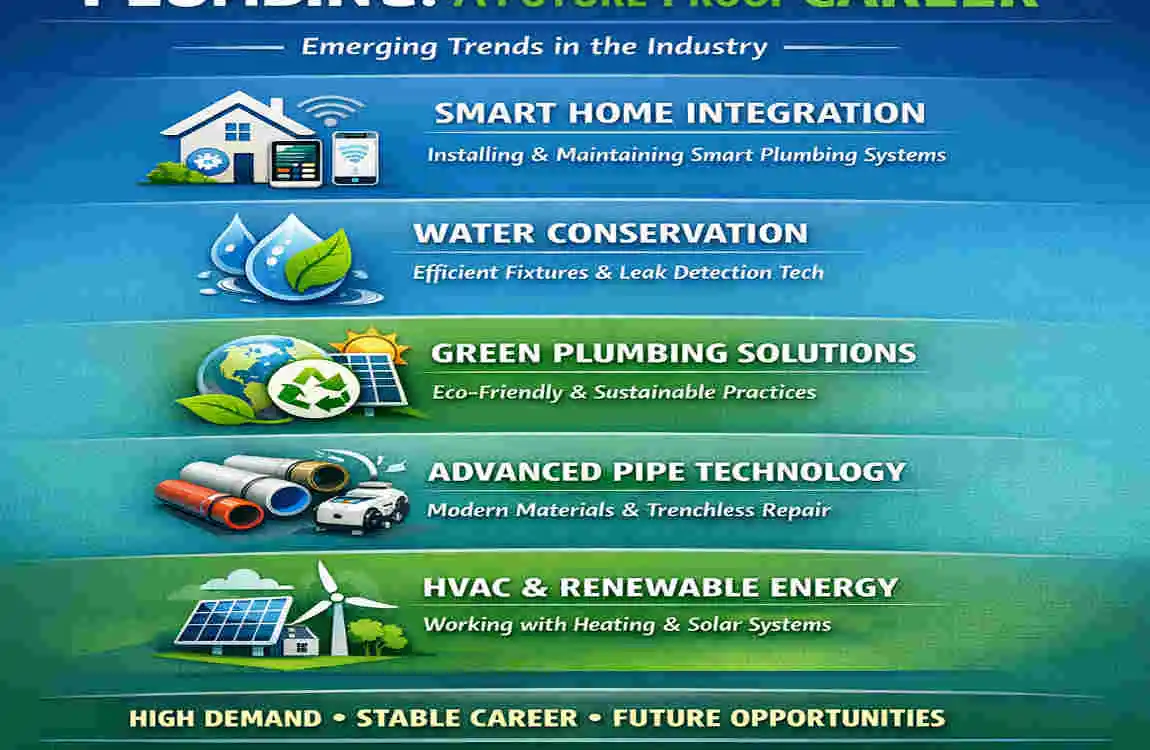
You might be wondering if technology will eventually make plumbers obsolete. The reality is quite the opposite. Technology is making the plumbing career prospects even more exciting.
Tech Integration and Smart Homes
We are entering the era of the “Smart Bathroom” and “Smart Kitchen.”
- Leak Detectors: Plumbers are now installing Wi-Fi-enabled leak detectors that automatically shut off the mains water via a phone app.
- Smart Pipes: Diagnostic tools that use sonic waves to find leaks behind walls without cutting into drywall.
- AI Diagnostics: Software that helps plumbers predict system failures before they happen. You won’t just be a mechanic; you will be a technician.
The Sustainability Boom
The world is going green, and plumbers are the soldiers on the front line of this battle.
- Water Conservation: As water becomes scarcer, low-flow toilets, rainwater harvesting systems, and greywater recycling are becoming standard.
- Energy Efficiency: Solar hot water systems and tankless heaters are in high demand.
According to the World Green Building Council, the demand for green building retrofits is skyrocketing. Plumbers who learn these “Eco-Plumbing” skills are seeing a faster-than-average growth in their business. By 2030, eco-plumbing is expected to grow at a 10% annual rate.
Post-Pandemic Shifts
Since the pandemic, more people have been working from home. This means home plumbing systems are in use 24/7, leading to more wear and tear and, subsequently, more repair calls. The remote work culture has ironically secured the plumber’s job even more.
Real Plumber Stories: Securing Futures, Fixing Homes
Statistics are great, but sometimes you need to hear from real people to understand the impact of this career.
The Lahore Success Story
Take the story of Ahmed (name changed for privacy), based in Lahore. Ahmed started as a helper for a local Ustad (master) at age 18. He didn’t have the funds for university. For three years, he rode a motorbike carrying tools, earning a daily wage.
However, Ahmed was smart. He watched YouTube videos on modern piping techniques and learned how to install luxury imported fixtures that the older plumbers refused to touch. He marketed himself on social media as a specialist for high-end Bahria Town residents.
Today, Ahmed is 28. He runs a registered company with a team of five. He has moved from a motorbike to a fleet of Suzuki vans. His income rivals that of mid-level corporate managers in the city, but he owns his time. His story is a testament to the fact that plumbing builds wealth and stability regardless of where you live.
The Career Switcher
Then there is Sarah in Ohio. She spent 10 years in retail management, burnt out, and capped out at $45k a year. At 32, she felt she was “too old” to restart. She took a leap of faith into a plumbing apprenticeship. She was the only woman in her class.
It was hard, but she found that her attention to detail—honed in retail—made her an excellent service plumber. Customers trusted her. Now, five years later, she is a Journeyman specializing in residential service, earning $82k a year with full benefits. She owns her home and has finally started saving for retirement.
Frequently Asked Questions (FAQs)
Here are answers to the most common questions people ask when considering this trade.
Is plumbing a good career choice for beginners?
Absolutely. It is one of the few high-paying careers that requires no prior experience or degree. The apprenticeship model is designed specifically to take a beginner from zero knowledge to a licensed professional.
What is the average plumber’s salary in 2026?
In the US, the average is hovering around $60,000 to $65,000, but this varies wildly. Experienced licensed plumbers often earn over $80,000, and business owners can earn double that.
How long does it take to become a licensed plumber?
It generally takes 4 to 5 years. However, remember that you are working and earning money full-time during these years. You aren’t just sitting in a classroom.
Are there plumbing jobs in Pakistan?
Yes, the market is huge, especially in growing urban centers like Lahore, Karachi, and Islamabad. As housing societies expand, the demand for plumbers who understand modern, high-end fittings is massive. There is a shortage of reliable, professional plumbers, creating a gap for you to fill.
Is the plumbing market oversaturated?
No. In fact, it is the opposite. With the older generation retiring and fewer young people entering the trades, there is a significant shortage of skilled plumbers.
Is plumbing hard on your body?
It can be. It involves lifting, kneeling, and working in tight spaces. However, modern tools have made it easier, and if you practice proper lifting techniques and stay fit, you can have a long, healthy career.
Can women become plumbers?
100%. The industry is actively recruiting more women. Women are often praised for their attention to detail and communication skills, which are crucial in residential plumbing services.