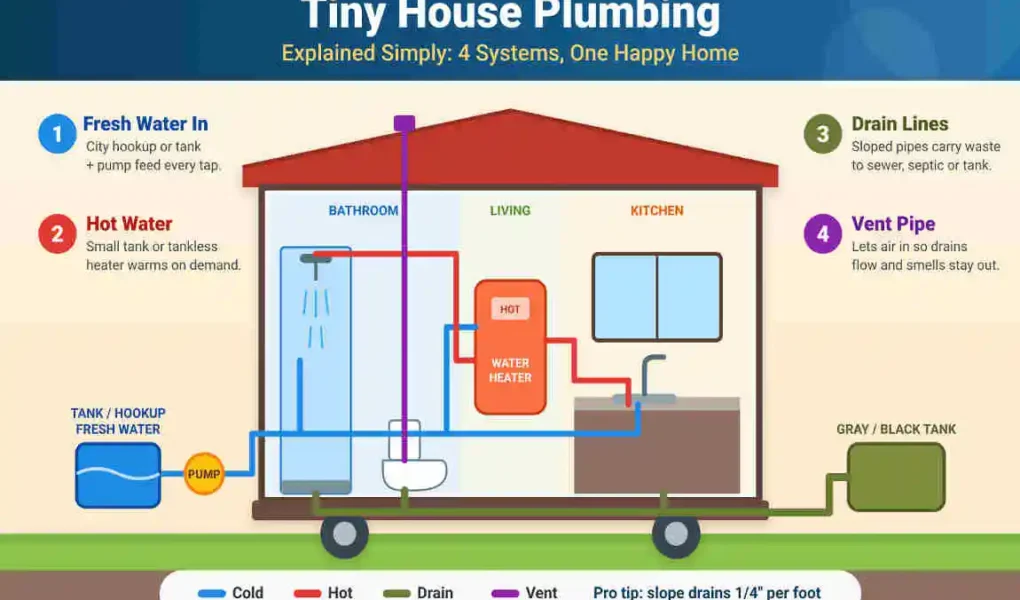
Plumbing in a tiny house works like plumbing in any home, only smaller. Fresh water arrives from a hookup, a tank with a pump, or a well. A compact heater warms it, fixtures use it, and gravity carries the used water through vented drain pipes to a sewer, septic system, holding tank, or a composting and greywater setup.
Tiny houses look simple from the outside, yet the plumbing is the part that makes homeowners nervous. Where does the water come from? Where does it go? What happens when it freezes? The good news is that none of it is mysterious. If you understand how a normal house handles water, you already understand about 90% of a tiny one.
How does plumbing work in a tiny house?
Tiny house plumbing is made of three connected systems, the same as in a full-size home.
- Supply: pressurized cold water is pushed to the sink, shower and toilet. In a tiny house the pressure comes from a hookup or from a small 12-volt pump.
- Hot water: part of that cold supply passes through a heater and continues to the fixtures on a second line.
- Drain-waste-vent (DWV): used water leaves by gravity through sloped pipes. Traps block sewer gases, and vent pipes let air in so the water can flow freely.
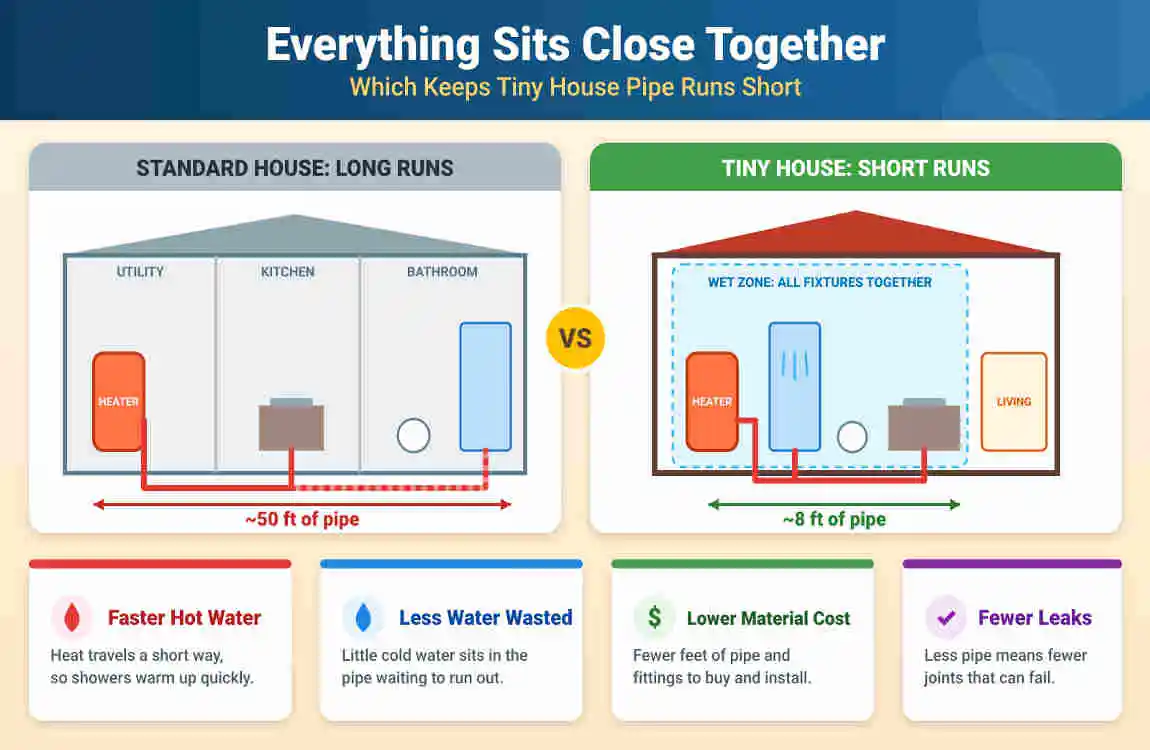
So what is actually different? Scale, mostly. A typical tiny house has one kitchen sink, one bathroom sink, one shower and one toilet, so it needs far less pipe and fewer fittings than a conventional home. That is the same observation made by plumbing code experts at Plumbing & Mechanical magazine, who note that tiny house systems are much like standard ones but use much less material (Plumbing & Mechanical). Short runs also mean hot water reaches the tap faster, which wastes less water.
Where does the water in a tiny house come from?
A tiny house can draw water from four main sources, and many owners combine two of them. The right choice depends on whether the home stays put or travels, and whether you are on a utility grid.
| Source | How it works | Best for | Watch out for |
|---|---|---|---|
| City or RV-style hookup | A hose or hard-piped line connects to an inlet on the house, usually with a pressure regulator and filter. | Homes parked on a lot or in a community | Hoses freeze in winter, and unregulated pressure can burst fittings |
| Fresh water tank and pump | A storage tank feeds a small pump that pressurizes the lines. | Off-grid or frequently moved homes | Refilling, sanitizing the tank, and running out mid-shower |
| Private well | A well pump and pressure tank deliver water to the house. | Rural land | Regular water testing and wellhead freeze protection |
| Rainwater catchment | Roof runoff is filtered and stored in a cistern. | A backup or non-drinking supply | Needs treatment before drinking, and local rules differ |
A hybrid setup is common: a hookup for everyday use plus a modest on-board tank so the house still works during a shutoff or while parked somewhere without services.
How does hot water work in a tiny house?
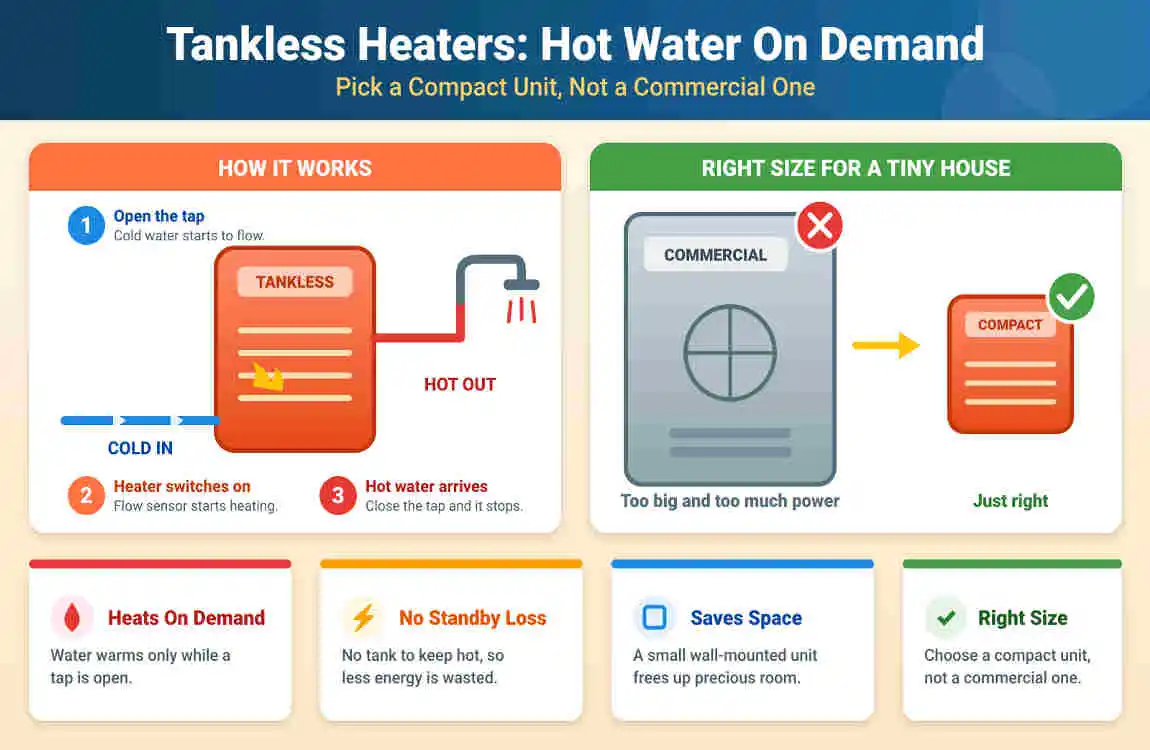
Most tiny houses use either a tankless (on-demand) water heater or a small storage tank. A tankless unit heats water only when a hot tap opens, so it avoids the standby losses of a tank. The U.S. Department of Energy reports that in homes using 41 gallons or less of hot water per day, demand-type heaters can be 24% to 34% more energy efficient than conventional storage tank heaters (U.S. Department of Energy). That range fits a tiny household well.
There are trade-offs to weigh before you buy:
- Flow rate: demand heaters typically deliver about 2 to 5 gallons per minute (Penn State EME 102). That is plenty for one shower, but not for two things at once.
- Electric power draw: the same Penn State course notes that electric units draw more instantaneous power than tank models, which matters if your home runs on a small electrical service.
- Venting: gas and propane units need a direct vent or flue to the outdoors, so plan the wall location early.
How do drains, traps and vents work without a basement?
Drains in a tiny house rely on gravity, exactly as they do in a large house. Every drain pipe must slope gently downward toward the outlet. Under common plumbing codes, small drain lines are often required to fall about a quarter inch per foot, but check your local code for the exact figure.
Each fixture also needs a trap, the curved section that holds a little water and stops sewer gas from drifting back in. A vent lets air enter the pipe behind the water so it does not glug, slow down or siphon the trap dry. Some jurisdictions allow air admittance valves in tight spaces; others require a pipe through the roof, so ask before you design the layout.
On a house built on a trailer, the drains are usually grouped so they exit at one point, often on one side, where a sewer or holding tank hose can be attached. Keeping fixtures clustered around a single wet wall is the single best way to shorten pipe and reduce cost. Leave access panels so you can reach traps and shutoff valves later.
What happens to toilet and sink wastewater?
Plumbers divide household wastewater into two streams. Gray water comes from sinks, showers and laundry. Black water comes from the toilet. Some jurisdictions also classify kitchen sink water as black water, so local definitions matter. In a tiny house you have four practical ways to handle waste:
- Connect to a sewer or septic system. This is the closest to a conventional home and the easiest for inspectors to approve.
- Use a black water holding tank. Waste is stored and emptied at a dump station, the way an RV works.
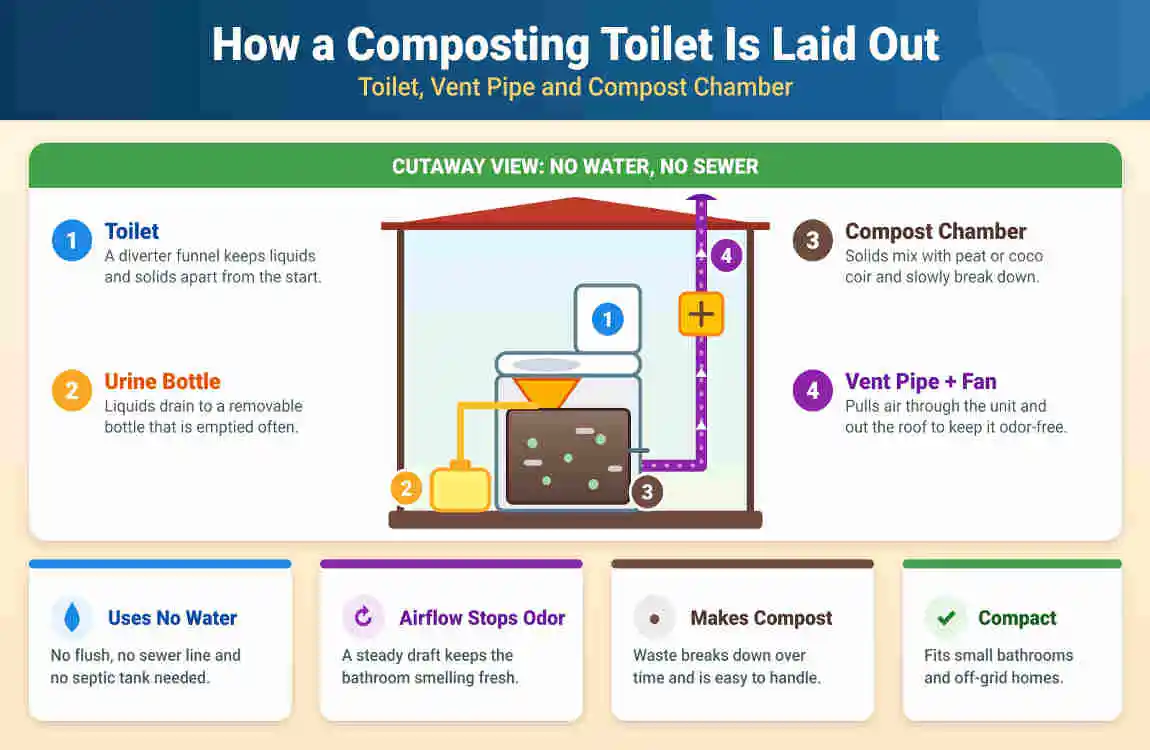
- Install a composting toilet. The U.S. EPA explains that composting toilets need little to no water and are used in seasonal homes, remote areas, and places where flush toilets are impractical (U.S. EPA fact sheet).
- Pair a waterless toilet with greywater reuse or disposal. The EPA describes onsite non-potable reuse as collecting water from sources such as sinks, treating it appropriately, and using it for non-drinking purposes (U.S. EPA Water Reuse).
Before you pick a route, confirm that your county or state permits it. Greywater rules in particular vary widely from place to place.
Which pipes work best, and how do you stop them freezing?
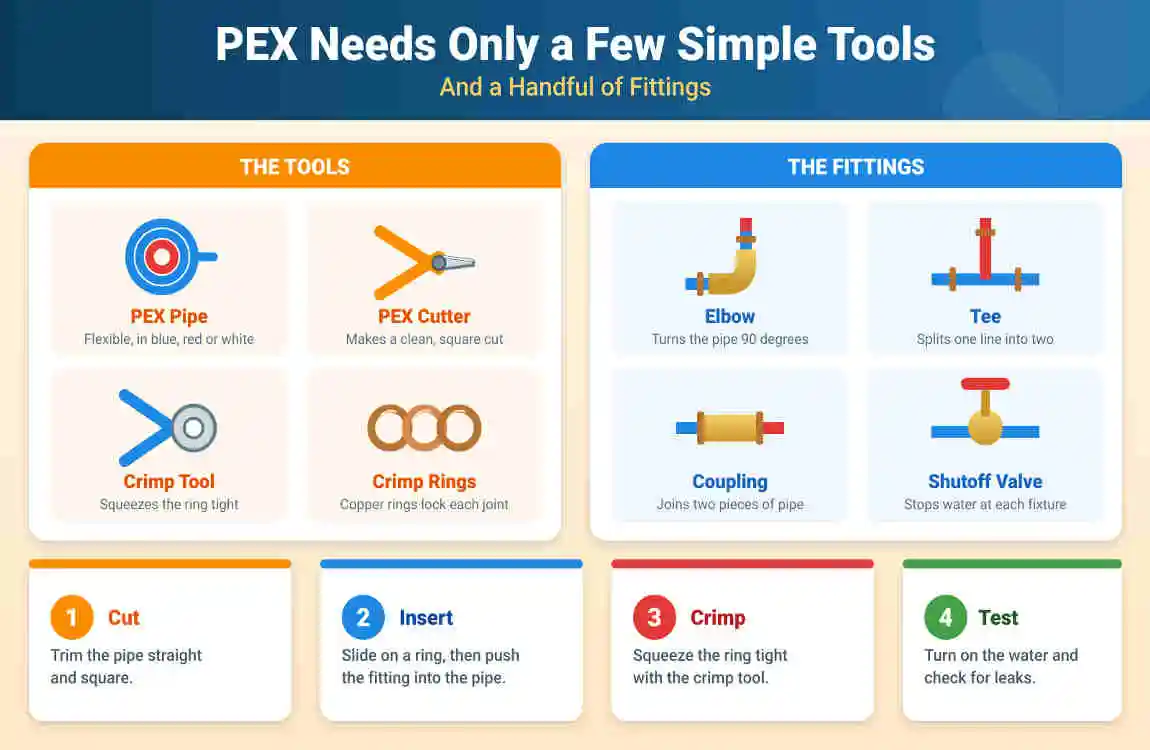
Most tiny house builders choose PEX, a flexible cross-linked polyethylene tubing. It bends around corners, needs fewer fittings, costs less than copper, and copes with vibration better than rigid pipe, which is useful if the house is ever towed. The National Association of Home Builders says PEX is more freeze resistant than rigid pipes, then adds an important warning: freeze resistant is not freeze proof, so pipe exposed to freezing air should be insulated (NAHB).
Good habits that apply to any pipe material:
- Keep supply lines inside the insulated part of the house, not in exterior walls or exposed under the trailer.
- Place a shutoff valve where you can reach it quickly, and another for the outdoor inlet.
- Use a pressure regulator on any hookup so city or campground pressure does not overload fittings.
- Use push-fit or crimp connectors designed for PEX, and support the tubing at regular intervals so it does not rattle.
Do water-saving fixtures matter in a tiny house?
They matter a lot, especially if you rely on a tank. Smaller storage means every gallon counts. The EPA notes that a standard showerhead uses 2.5 gallons per minute, while a WaterSense labeled showerhead must use no more than 2.0 (U.S. EPA WaterSense). ENERGY STAR adds that WaterSense labeled faucet aerators and showerheads use at least 20 percent less water than standard models while performing as well or better (ENERGY STAR). Less water used also means less water to heat, so you save energy too.
Do tiny house plumbing systems have to meet code?
Usually, yes, though the exact code depends on how your home is built and used. The International Code Council defines tiny houses in the 2021 International Residential Code, Appendix AQ, as dwelling units of 400 square feet or less in floor area, excluding lofts (International Code Council). The appendix first appeared as Appendix Q in the 2018 code and was described as the first set of building standards for dwellings of this kind to be added to a model code (ICC Building Safety Journal). On the plumbing side, the 2021 National Standard Plumbing Code added its own appendix for tiny houses (Plumbing & Mechanical).
The rules are still evolving. In 2023 the Code Council and the Tiny Home Industry Association began a standards process to update tiny house requirements as ICC/THIA Standard 1215 (ICC news release).
Wheels add a wrinkle. According to an ICC and Tiny Home Industry Association guide, a tiny house used only temporarily or seasonally on a chassis may be covered by recreational vehicle standards, while permanent homes generally follow the residential code (ICC guide for policymakers, builders and code officials). Always check with your local building department before you plumb anything.
Tiny house plumbing winter checklist
- Insulate every exposed supply line, and keep tanks inside the heated, insulated envelope.
- Switch to a heated drinking-water hose or heat tape on any outdoor connection.
- During a hard freeze, let both hot and cold taps trickle overnight.
- Know where your main shutoff is, and test it before winter.
- If the house will sit unheated, drain the system and the water heater. RV-style systems can be protected with non-toxic RV antifreeze.
- Check wastewater lines and holding tanks, since frozen drains cause problems too.
Seven common tiny house plumbing mistakes
- Skipping the pressure regulator on a hookup.
- Flat or backward drain slope that leaves standing water in the line.
- No vent, or a vent that does not meet local rules.
- Choosing an electric tankless heater without checking available amperage.
- Burying shutoff valves and traps behind permanent panels.
- Leaving a hose connected during a freeze.
- Assuming a waste option is legal before asking the local health department.
Tiny house plumbing FAQ
Do tiny houses have regular plumbing?
Yes. A tiny house has the same three systems as any home: pressurized water supply, hot water, and a gravity-fed drain, waste and vent system. The difference is scale, shorter pipe runs, and more options for where water comes from and where waste goes.
Does a tiny house need a septic system?
Not always. It can connect to a municipal sewer or a septic system, use a holding tank emptied at a dump station, or use a composting toilet with a separate greywater plan. Your local health department and building code decide what is allowed.
How do tiny houses get hot water?
Most use a compact tankless heater or a small storage tank heater. The U.S. Department of Energy says demand-type heaters can be 24% to 34% more efficient than storage tank models in homes using 41 gallons or less of hot water daily.
Can a tiny house use a regular flush toilet?
Yes, if it connects to a sewer, septic system or black water tank. Where that is not possible, a composting toilet is a common waterless alternative.
Is PEX a good choice for tiny house plumbing?
Yes, for most builds. It is flexible, affordable and more freeze resistant than rigid pipe, but it still needs insulation where cold air can reach it.
Do tiny houses on wheels have to follow building codes?
It depends on how the home is used and where it is parked. Permanent homes can fall under the International Residential Code, including Appendix AQ, while some seasonal units on a chassis may follow recreational vehicle standards. Confirm with your local building department.
How do you stop tiny house pipes from freezing?
Keep pipes and tanks inside the insulated envelope, insulate exposed lines, use heat tape or a heated hose where needed, know your shutoff valves, and drain the system if the home will sit unheated in freezing weather.
The bottom line
Tiny house plumbing is ordinary plumbing, shrunk down and planned with care. Choose a water source that fits how you live, keep fixtures clustered, protect pipes from cold, and settle your waste plan with your local officials before you build. Do that, and the plumbing will be the least dramatic part of living small.
Sources
- International Code Council: Tiny Homes
- ICC Building Safety Journal: The International Residential Code Has a Big Vision for Tiny Houses
- ICC news release: ICC and THIA initiate standards process (April 4, 2023)
- ICC: Navigating Certification and Regulation of Tiny Houses
- Plumbing & Mechanical: Codes Corner, A Larger Perspective on Tiny House Plumbing
- U.S. Department of Energy: Tankless or Demand-Type Water Heaters
- Penn State EME 102: Demand Water Heaters
- U.S. EPA WaterSense: Showerheads
- ENERGY STAR: Saving Water Helps Protect Our Nation’s Water Supplies
- U.S. EPA: Water Efficiency Technology Fact Sheet, Composting Toilets
- U.S. EPA: Onsite Non-Potable Water Reuse Resources
- National Association of Home Builders: Why PEX Is the Best Pipe for Winter Weather and Beyond