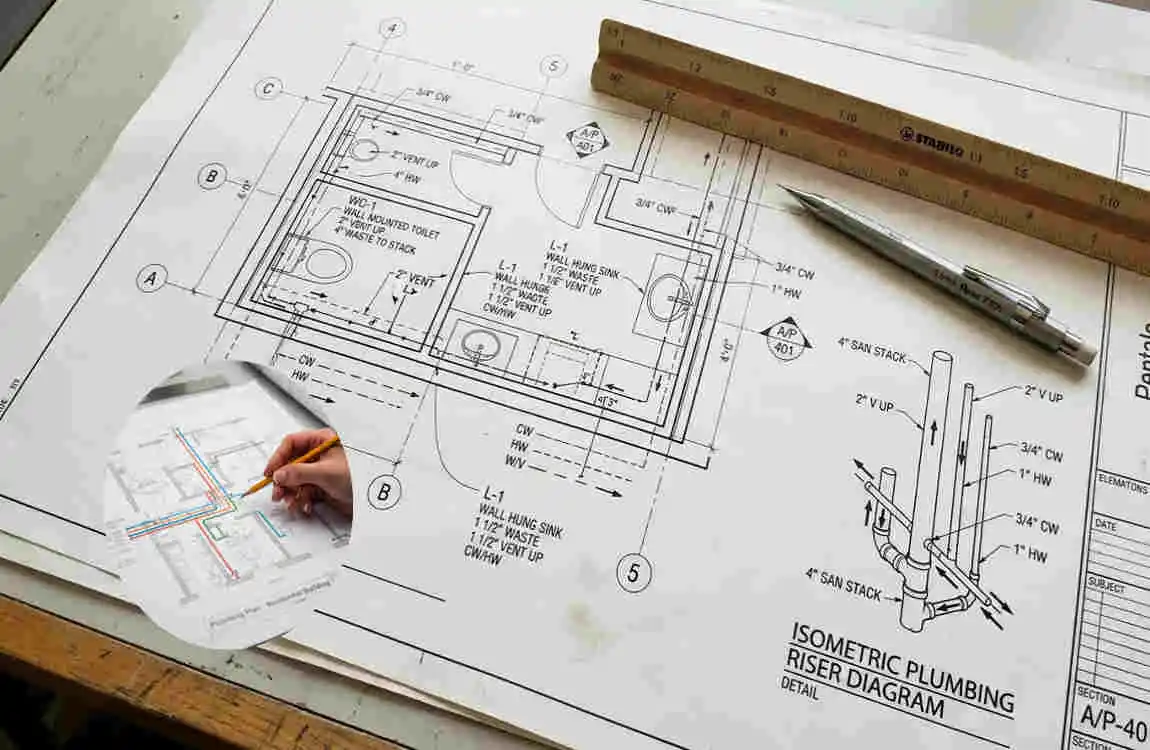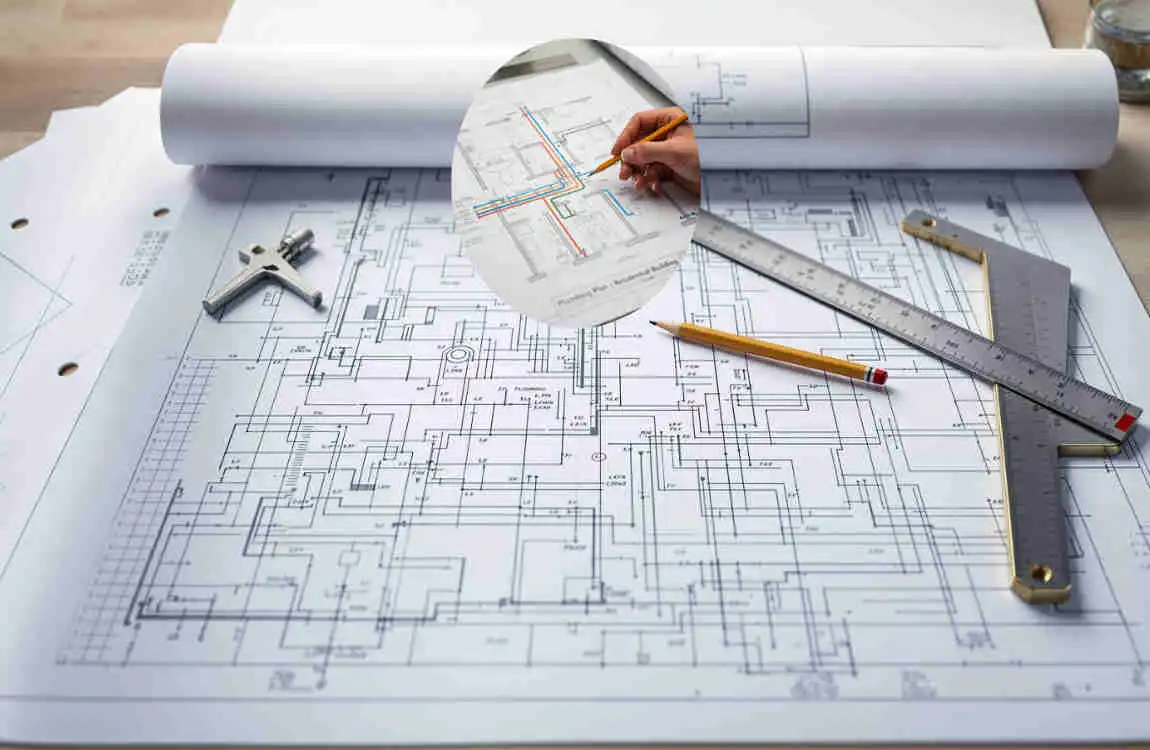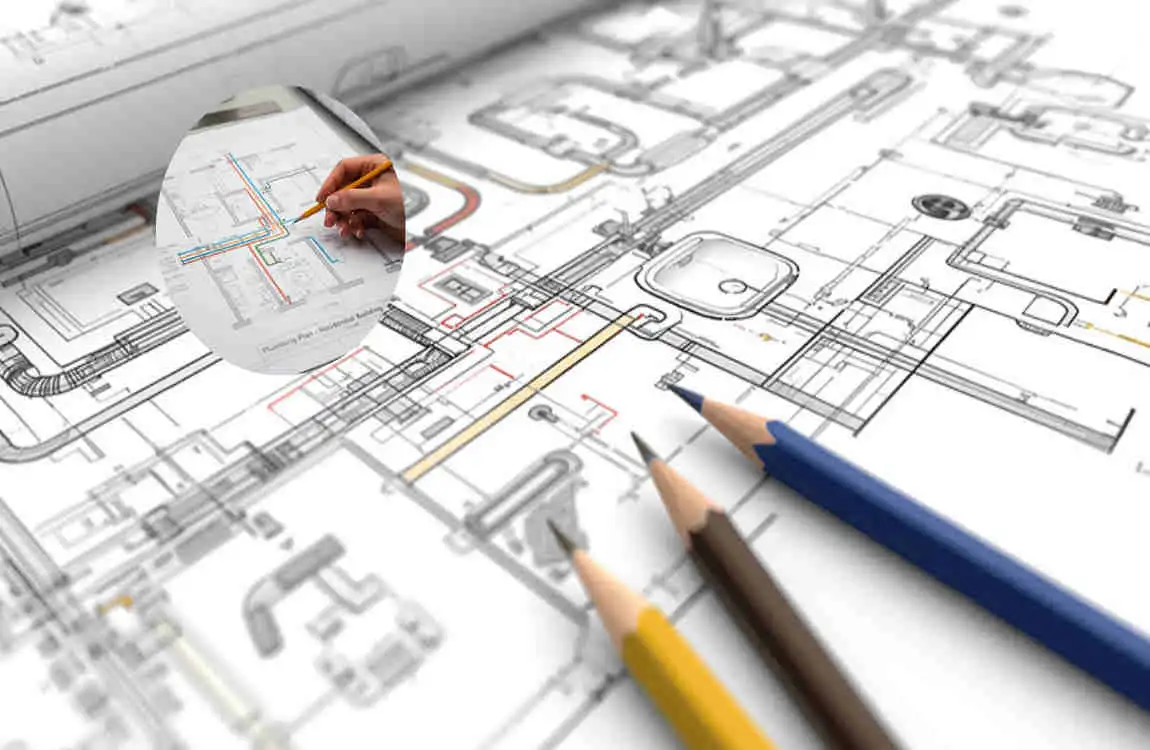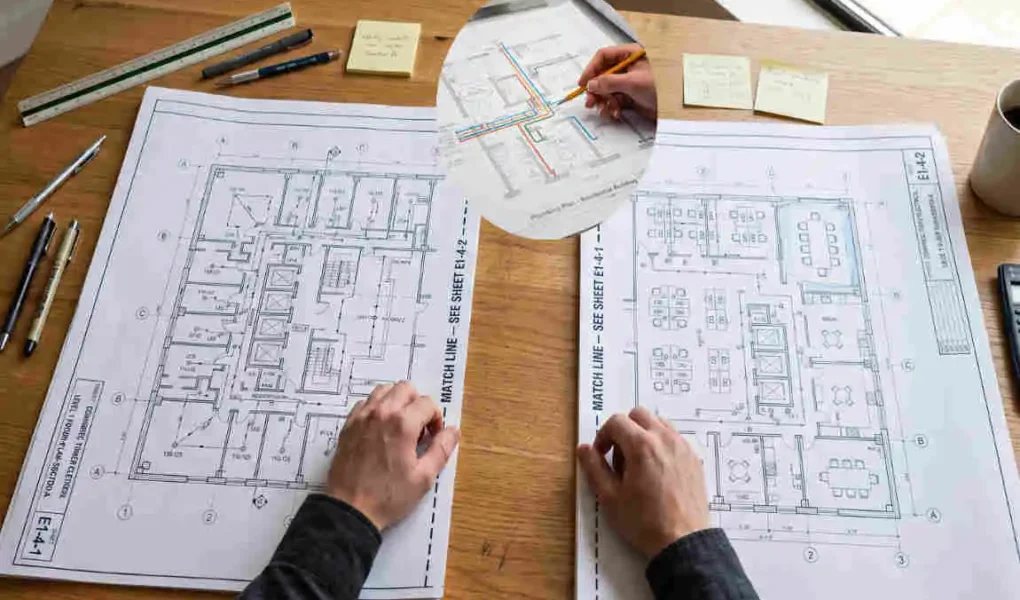
If you have ever opened a wall, planned a bathroom remodel, or tried to understand why water moves the way it does in a multi-story home, you have probably run into one big question: what is a plumbing riser diagram?
A house plumbing riser diagram is a clean, vertical drawing that shows how pipes move through a home from one floor to another. It maps the water supply, drainage, and vent lines in an easy-to-follow manner. Instead of showing every small detail, it focuses on the main vertical paths, also called risers, so plumbers, builders, and homeowners can see how the system connects across floors.
| Aspect | Details | Purpose |
|---|---|---|
| Diagram Type | 2D elevation or 3D isometric | Clear vertical pipe paths across stories |
| Included Elements | Supply lines, DWV (drain-waste-vent), sizes, notes on slopes/supports | Fixture connections and building drains |
| Not Included | Full floor plans or horizontal branches | Focuses on vertical “backbone” only |
| Benefits | Prevents malfunctions, aids multi-floor installs | Code checks and plumber workflows |
What Is a Riser Diagram Plumbing?

A riser diagram plumbing is a 2D vertical schematic that shows how plumbing systems move through a building from floor to floor. It is not a fancy artistic drawing. It is a working guide.
The diagram usually shows:
- Cold water supply lines
- Hot water supply lines
- Drain lines
- Waste stacks
- Vent stacks
- Fixture connections
- Shutoff valves
- Floor labels and heights
In a house, the diagram often starts at the main supply point, such as the meter, basement entry, or pump location. From there, the lines rise upward through each level of the home and connect to sinks, showers, toilets, tubs, washing machines, and water heaters. At the same time, the drain and vent paths show how wastewater safely leaves the system.
The word “riser” refers to pipes that rise vertically through the structure. That is the key idea. A riser diagram does not try to show the full horizontal layout of every pipe in every room. Instead, it focuses on the important vertical movement between floors.
Why It Is Not the Same as a Floor Plan
A floor plan shows the layout of a single level from above. It helps you understand where a bathroom, kitchen, or laundry room sits.
A riser diagram does something different. It shows how the plumbing travels up and down through the home.
That makes it especially useful in:
- Two-story homes
- Townhouses
- Basement-to-attic systems
- Homes with multiple bathrooms
- Additions or remodels
So when someone asks, “What is a riser diagram in plumbing?” the best answer is: it is a visual map of the vertical plumbing structure of a home.
Why It Matters in Simple Terms
Think of it like this.
If a floor plan is the map of a city street, the riser diagram is the map of the bridges, tunnels, and towers that connect the city at different heights. Both are useful, but they solve different problems.
A plumber uses a riser diagram to understand quickly:
- Where water enters
- How it moves upward
- Where waste exits
- How the vents balance pressure
- Which fixtures depend on which pipe runs
That is why a house plumbing riser diagram is such an important part of the overall plumbing package.
Illustration idea 2: Side-view drawing of a two-story home with labeled supply, drain, and vent risers.
Main Types of Plumbing Risers
A plumbing riser diagram usually contains more than one type of vertical pipe. Each one has a job. Understanding the main types makes the whole drawing easier to read.
TypeDescriptionHouse ExampleCommon Color Hint
Water Supply Riser Carries fresh water upward to fixtures Main line feeding upstairs bathrooms Blue for cold, red for hot
Waste / Soil Stack Moves waste water and sewage downward Toilets, tubs, and sinks draining to sewer Often shown in dark linework
Vent Stack Releases air and gas to keep pressure balanced Pipe rising through the roof Often shown as dashed or labeled line
Storm Riser Carries roof runoff or rainwater Downspouts or gutter connections Usually marked separately
Water Supply Riser
This is the line that brings clean water to the home’s fixtures.
In many homes, the supply begins at the street connection, meter, or pressure source. From there, it rises to the upper floors and branches out to sinks, showers, toilets, and appliances. Hot and cold water are usually shown separately so the system is easy to follow.
Waste or Soil Stack
This is the vertical pipe that carries used water and sewage away from fixtures.
It is important because toilets, showers, sinks, and tubs all depend on proper drainage. If the waste stack is blocked, undersized, or poorly sloped, the whole system can start to fail.
Vent Stack
A vent stack may not carry water, but it still plays a big role.
It allows air to move in and out of the drainage system, helping water drain smoothly and preventing pressure problems. It also helps reduce sewer gas buildup inside the home.
Storm Riser
In some homes, stormwater also gets its own vertical path.
This is common when roof runoff or gutter drainage needs to be guided away from the structure.
Residential vs. Commercial Scale
A house plumbing riser diagram is usually simpler than a commercial one. A home diagram focuses on fewer floors, fewer fixtures, and a more compact layout. A commercial diagram may involve many more branches, multiple zones, and larger pipe sizes.
That is why a residential riser diagram is often much easier to read once you understand the basic symbols.
CTA: If you are renovating a bathroom or installing a new floor, request a plumbing riser diagram before work begins.
Illustration idea 3: Color-coded vertical pipe chart showing supply, waste, vent, and storm paths.
Key Components of a House Plumbing Riser Diagram
A plumbing riser diagram is useful because it shows several important parts in one place. Once you understand those parts, the drawing becomes much less confusing.
Pipes and Sizes
Different pipes serve different purposes, and each usually requires a different size.
A supply line may be smaller than a waste line because water under pressure moves differently from drain water. Common residential materials include:
- PVC
- Copper
- PEX
Each one has a place in home plumbing. The diagram may also show pipe sizes such as:
- 1/2 inch
- 3/4 inch
- 1 inch
- 3 inch
- 4 inch
The actual size depends on the fixture load, the number of fixtures connected, and local code requirements.
A riser diagram plumbing does not always show every small branch with exact detail. But it should show enough information to tell you which pipes handle supply and which handle drainage.
Fixtures and Connections
The diagram usually shows where the plumbing connects to actual fixtures.
These may include:
- Toilets
- Sinks
- Showers
- Bathtubs
- Dishwashers
- Water heaters
- Laundry machines
Each fixture has its own connection point. For example, a toilet connects to the waste stack and needs proper venting. A sink needs both a supply and a drain connection. A shower usually connects to supply lines, a trap, a drain, and a vent path.
That is why a house plumbing riser diagram is more than just a pipe sketch. It is a full relationship map between pipes and the things they serve.
Valves and Shutoff Points
Valves are very important because they let you isolate a section of the system.
If a leak happens upstairs, a shutoff valve can prevent a larger mess. If a fixture needs repair, the valve gives the plumber a fast way to stop the flow without turning off water to the whole house.
Some diagrams show:
- Main shutoff valve
- Fixture shutoffs
- Branch isolation valves
- Water heater valves
If you are a homeowner, these are some of the most valuable marks on the page. They tell you where control points are located.
CTA: Before your next repair, locate the shutoff valves and label them clearly.
Story Heights and Floor Labels
A good riser diagram should tell you which line belongs to which floor.
That can be done with:
- Floor labels
- Level markers
- Height notes
- Basement, first floor, second floor, roof labels
This is especially helpful in multi-story homes, as the same line may pass through several levels before terminating at a fixture or vent.
Meter Locations and Entry Points
The beginning of the system matters just as much as the top.
The diagram often shows:
- Water meter location
- Main supply entry
- Pump connection
- Basement feed
- Main sewer exit
These points help define the plumbing’s starting and ending positions.
Cross-Connections and Shared Systems
Some homes have plumbing that overlaps with other systems. In certain plans, the riser diagram may also note connections that interact with:
- HVAC
- Fire suppression
- Mechanical rooms
- Water heating systems
This is useful because the plumber does not work in a vacuum. The plumbing often shares space and sometimes coordination with other building systems.
A Sample Text-Based Riser Diagram
Here is a simple example of how a house plumbing riser diagram might be described in text form:
- Basement: Main water enters at meter; water heater located nearby; main shutoff installed.
- First Floor: Kitchen sink, powder room toilet, and laundry connection branch from supply riser.
- Second Floor: Master bath sink, shower, and toilet connect to vertical supply and waste lines.
- Roof: Vent stack extends through roof for air balance and gas release.
- Drain Exit: Waste stack discharges to the main sewer connection at the basement level.
This kind of summary helps you picture the system even before you see the drawing.
Illustration idea 4: Annotated home plumbing schematic with labels for basement, first floor, second floor, and roof vent.
Why a Riser Diagram Matters in Design and Construction

Many homeowners only think about plumbing when something goes wrong. But in design and construction, the riser diagram does its best work before problems begin.
It Helps Prevent Mistakes Early
When a project starts, the riser diagram provides the team with a plan for how water and waste will flow through the home. That helps avoid surprises later.
Without it, a contractor may discover too late that:
- A pipe path clashes with a beam
- A bathroom layout needs more space
- A vent line is missing
- A pipe size is too small
- A wall opening hits a hidden line
That can lead to delays, rework, and higher costs.
It Supports Code Compliance
Every region has plumbing rules, and those rules matter.
A riser diagram helps show whether the planned layout fits local building and plumbing requirements. It may support compliance with commonly used code systems like IPC or UPC, but the exact rules depend on your area.
That is why a riser diagram plumbing is not just a convenience. It can be a real planning tool.
It Saves Time and Money
A clear diagram helps the plumber work with more confidence.
Instead of guessing where the pipes run, the plumber can follow the plan. That means fewer mistakes, fewer surprises, and often fewer costly revisions.
For a small project, this may save time. For a large remodel or multi-story house, it can save a lot more.
It Makes Coordination Easier
Construction work rarely involves only one trade.
Plumbers, electricians, HVAC workers, and builders all need space to do their jobs. A riser diagram helps everyone understand where the plumbing is going so they can avoid conflicts before they happen.
CTA: If you are building a new home, request the riser diagram before framing begins.
Illustration idea 5: Construction site drawing with plumbing lines coordinated against wall framing.
Why It Matters for Maintenance and Repairs
A riser diagram is not only for builders. It is also a powerful tool for repair work.
It Makes Leak Tracing Easier
A leak on an upper floor can be hard to track.
Water often travels along hidden paths before it shows up as a stain, drip, or damp spot. If you have a riser diagram, you can narrow down which supply or drain line may be involved.
That is a big advantage when time matters.
It Helps With Clogs and Drain Problems
Drain clogs are not always isolated to one fixture.
Sometimes a blockage in the waste stack affects multiple fixtures across the house. A riser diagram shows which toilets, sinks, or tubs share the same vertical path, which makes troubleshooting much faster.
It Supports Remodels and Additions
If you are adding a bathroom, moving a kitchen sink, or finishing a basement, the diagram helps you understand what already exists.
This is important because remodels can unintentionally overload the system or disrupt the venting layout. A good plan helps you build safely and avoid future problems.
It Helps With Ongoing Care
A homeowner who understands the plumbing layout can spot issues earlier.
For example, if you know where the waste stack runs, you may notice a change in sound, flow, or pressure before a major problem develops. That kind of awareness can prevent expensive repairs later.
CTA: If you notice recurring leaks, have the plumbing layout reviewed before the next repair starts.
Illustration idea 6: Leak tracing diagram with arrows showing how water may move through walls and floors.
Why Homeowners Should Care About Riser Diagrams
Some people think plumbing drawings are only for professionals. That is not true.
A homeowner can benefit greatly from understanding the plumbing riser diagram of their house.
It Helps When Buying a House
If you are buying a home, a riser diagram can reveal a lot about the plumbing system.
It may help you understand:
- How old the system is
- Whether the layout looks organized
- How many fixtures are tied to one stack
- Whether future upgrades may be difficult
That does not replace a professional inspection, but it gives you a much clearer picture.
It Helps When Selling a House
If you are selling, having a clean plumbing diagram can be a strong plus.
It shows that the home has been maintained with care. It also makes buyers feel more confident, especially if they want to remodel in the future.
It Helps With Insurance and Maintenance Records
Good documentation matters.
If you keep a diagram along with repair notes and maintenance records, you can show that the home has been cared for responsibly. That may help in conversations with insurers, contractors, or future buyers.
It Gives You More Confidence
This is one of the most overlooked benefits.
When you understand how your plumbing works, you feel more in control. A small issue does not seem as scary. You know where to look, who to call, and what questions to ask.
That confidence is worth a lot.
Illustration idea 7: Homeowner reviewing a riser diagram with a contractor at the kitchen table.
How to Read a Plumbing Riser Diagram
Reading a riser diagram may seem hard at first, but it becomes easier once you know what to look for.
Find the Main Entry Point
Start at the bottom of the diagram.
Look for the point where the water enters the home. This may be labeled as the meter, main supply, basement entry, or pump connection.
That point is your starting place.
Follow the Vertical Lines
Next, trace the lines upward.
These are the risers. They usually move from basement to first floor, then to second floor, and sometimes up to the roof. Follow the line slowly to see which fixtures it serves.
Read the Symbols
The diagram will likely use symbols to show fixtures, valves, or pipe changes.
A circle may stand for a valve. A box or icon may mark a sink or toilet. A dashed line may show a vent. A bold line may show a supply pipe.
Once you recognize the symbols, the drawing becomes much easier to understand.
Check the Labels
Labels are your best friend.
They often show:
- Pipe sizes
- Floor names
- Fixture names
- Line type
- Direction of flow
If you are unsure about a mark, the label usually gives you the answer.
Identify the Vent Path
Vent lines are easy to miss, but they matter a lot.
Look for the line that continues upward toward the roof. That tells you how the system balances pressure and releases sewer gas.
Match the Diagram to the Real House
A diagram is only helpful if you connect it to the actual building.
Please compare the drawing to the house’s layout. Where is the bathroom? Which wall is the water heater on? Where does the basement line rise? This makes the diagram feel more real than abstract.
Symbol Meaning Example Use
Solid line Water supply pipe Hot water riser to upstairs bath
Dashed line Vent line Air path to roof termination
Circle Valve Shutoff point near sink
Square or icon Fixture Toilet, sink, shower
Arrow Flow direction Water or waste movement
A Real-World Example
Imagine a two-story house with a basement water heater.
The diagram may show:
- The main supply entering in the basement
- A water heater connected near the entry point
- A hot water riser moving up to the kitchen and both bathrooms
- A cold water riser feeding all fixtures directly
- A waste stack dropping from upstairs bathrooms to the sewer exit
- A vent stack continuing through the roof
If you can trace those six things, you are already reading the diagram well.
Before your next repair, ask for the riser diagram and trace it by hand once.
Illustration idea 8: Step-by-step numbered riser diagram with arrows from supply entry to roof vent.
How to Create a House Plumbing Riser Diagram

If you are making a house plumbing riser diagram, you need clarity more than artistic skill. The goal is to make the layout easy to understand.
Option 1: Create It Yourself
For a simple home, you can sketch a basic version yourself.
You can use:
- Graph paper
- Simple drawing software
- CAD tools
- Basic design apps
- Free diagram tools
The process usually looks like this:
- Measure the building height and floor levels
- List every plumbing fixture
- Mark where the main water enters
- Mark the water heater and shutoff points
- Draw the supply risers
- Draw the waste stack and vent lines
- Add labels for each floor and fixture
- Check the layout against the real home
That does not mean the sketch is complete for permit work, but it is a good start.
Option 2: Hire a Professional
For new builds, larger homes, or complicated remodels, a professional is often the better choice.
A plumber, drafter, or mechanical designer can create a cleaner, more accurate version that is easier to use during construction or inspection.
This is especially important if the home has:
- Multiple bathrooms
- More than two stories
- Complex venting
- Basement plumbing
- Additions or converted spaces
When a Pro Makes the Most Sense
You should strongly consider a professional if:
- You are applying for permits
- The home is large or multi-level
- You are changing fixture locations
- You suspect old or undocumented pipe work
- You need the diagram for resale or insurance
What a Simple Template Might Look Like
Here is a text version of a basic template:
- Basement: Water meter, main shutoff, water heater, sewer connection
- First Floor: Kitchen sink, powder room, laundry line
- Second Floor: Bathroom sink, toilet, shower
- Roof: Vent stack exit
A real diagram would include pipe sizes, labels, and symbols. But even this simple outline helps you think in vertical layers.
Illustration idea 9: Clean DIY-style template showing floor-by-floor plumbing notes.
Common Mistakes People Make With Riser Diagrams
A riser diagram is only useful if it is accurate and easy to read. Here are some mistakes that can cause trouble.
Leaving Out Fixture Labels
If a line is drawn but not labeled, the diagram becomes vague.
Always mark what each line serves. “Toilet,” “kitchen sink,” and “water heater” are better than just blank symbols.
Mixing Up Supply and Drain Lines
Supply lines and drain lines do very different jobs.
If they are not clearly separated, someone reading the diagram may misunderstand the system and make the wrong repair.
Forgetting the Vent Path
This is a big one.
A system may look complete on paper but still fail if the vent path is unclear or missing. Venting is part of the whole system, not an optional extra.
Not Updating the Diagram After Renovations
Homes change over time.
If someone adds a bathroom, moves a laundry room, or reroutes a pipe, the old diagram can become outdated. That can create confusion later.
Using a Diagram That Is Too Messy
A good riser diagram should be readable at a glance.
If the page is cluttered, crowded, or filled with unclear marks, it stops being useful. Simplicity matters.
After every remodel, update the plumbing diagram to match the actual house.
Illustration idea 10: “Before and after” comparison of a messy diagram versus a clean labeled diagram.
Practical Tips for Homeowners
If you want to get the most from a house plumbing riser diagram, keep these simple tips in mind.
Keep a Copy With Your Home Records
Store the diagram with:
- Warranty papers
- Inspection reports
- Repair receipts
- Remodel permits
- Appliance manuals
This creates a useful home file that saves time later.
Mark the Shutoffs
If you know where the main and fixture shutoffs are, mark them clearly on the diagram and in the house itself.
That way, when a leak happens, you do not waste precious minutes searching.
Ask for As-Builts
If work has already been done on your home, ask for as-built drawings whenever possible.
These show how the plumbing was actually installed, not just how it was planned.
Use the Diagram During Inspections
A riser diagram can help during:
- Pre-purchase inspections
- Annual maintenance
- Leak investigations
- Remodeling consultations
It gives the inspector or plumber a strong starting point.
Do Not Guess When in Doubt
If the diagram is unclear, do not guess at pipe direction or function.
Call a plumber or building professional and have it checked. Guessing in plumbing can lead to costly mistakes.
FAQs About What Is a Riser Diagram Plumbing
What is a riser diagram plumbing used for?
A riser diagram in plumbing shows how a home’s plumbing runs vertically through the building. It helps with design, maintenance, repairs, inspections, and remodels. It gives a clear picture of supply, waste, and vent lines.
Is a riser diagram the same as an isometric drawing?
No. A riser diagram is usually a simplified vertical schematic. An isometric drawing often shows the plumbing in a more angled, 3D-like view. Both are useful, but they serve different purposes.
Why do plumbers need it?
Plumbers use it to understand how pipes connect between floors, where shutoffs are located, and how the drain and vent system is arranged. It saves time and reduces mistakes.
Can I make my own plumbing riser diagram for my house?
Yes, you can make a simple version for your own reference. But for permits, large homes, or major remodels, it is better to have a professional create or review it.
How much does one cost?
The cost depends on the home’s size, the plumbing complexity, and whether it is part of a larger design package. A simple home drawing will cost less than a complex multi-story plan.
Does code require it?
That depends on your local rules and the type of project. Some projects may require formal drawings, while others may not. Always check with your local building office or your plumber before starting work.
What if my house does not have one?
Many older homes lack an up-to-date riser diagram. If that is the case, you can create one during a remodel, inspection, or system update so future work is easier.